Pages

Showing posts with label 20mm. Show all posts

Saturday, April 25, 2026

336-я отдельная гвардейская бригада морской пехоты - 336th Separate Guards Marine Brigade


336-я отдельная гвардейская бригада морской пехоты 

336th Separate Guards Marine Brigade


Another project running behind is my separate Naval Brigade project. I will be using my Esci plastic soviet infantry with a number Elhiem metal for this project with metal, plastic artillery and 3d printed resin, Diecast and plastic vehicles. 


The 336th consisted of three battalions of Naval Infantry equipped with the amphibious BTR 60 armored personnel carriers, a tank battalion with two companies of PT-76 amphibious light tanks and a company of T-55 main battle tanks. Artillery support was provided by a battery of BM-21 Grad multiple rocket launchers and a battery of anti-tank guided missiles, while air defense consisted of a platoon of ZSU-23-4 Shilka anti-aircraft guns and a platoon of 9K31 Strela-1 surface-to-air missiles. Support units included support, reconnaissance, engineer, and NBC defense battalions.


Brigade Headquarters

BTR-60 R-145BM 
MTLB tow 2B9 Vasileks
Bdrm-2 konkurs 
Gaz 66
Ural 4320 truck 

877th Naval Infantry Battalion

BTR 60 PB
BTR 60 PB
BTR 60 PB
2S9-1 Sviristelka (marine version)

878th Naval Infantry Battalion

BTR 60 PB
BTR 60 PB
BTR 60 PB
2S9-1 Sviristelka

879th Naval (Air Landing) Infantry Battalion

Parachutist Morskaya Pekhota would be GAZ-66 mounted
 Konkurs and SPG-9 teams UAZ 469
2S12 120mm mortars towed by UAZ 469
AGS-17 teams UAZ 469

884th Naval Infantry Battalion

BTR 60 PB
BTR 60 PB
BTR 60 PB
2S9-1 Sviristelka

112th Tank Battalion

T-55 AMD 
MTU-20 bridgelayer 
1st Company PT-76 x 3 
2nd Company PT-76 x 3 
3rd Company T-55AM x 3

887th Reconnaissance Battalion

BRDM-2's, PT-76's, Gaz 66 and Razv
2 x Mi8T

1612th Artillery Battalion


IV18 Erable -1 Command BTR -60
IV119BTR D 
BM 21 GRAD
BM 21 GRAD
D30 122mm Ural 4320
D1 152mm Ural 4320
Mor. 2S12 120mm  - UAZ-469 (airborne element) 

1618th Anti-Aircraft Missile Battalion


ZSU-23-4M3 Biryusa and BRDM Strela-1.

1615th Multi-Rocket Launcher Artillery Battalion

2 x 2S1 Gvozdika

1621st Anti-Tank Artillery Battalion 

2 x MT-12 Rapira 100mm's

2 x BRDM-2 Konkurs

2 x MT-LB Shturm-S.

Engineer battalion

Sapper company 8, 2 x flamethrowers 
UR -67  mine clearance vehicle 
Brem 2 recovery vehicle 
T-55O flame thrower tank 
MTLB x2
PTS-M Mun logistics vehicle.

Friday, January 2, 2026

2026 projects list


 2026 is upon us and future projects are starting to flood my ideas of what is possible to do this year. So I commenced a list over the last few days of possible projects. This year I do want to complete a few of the smaller armies and add additions to my other collections. 

In no real order of priority 

  • Main Project US 2nd Armoured and 90th infantry Division additions of 18 Sherman’s, 12 halftracks, 12 trucks, 6 jeeps, SP artillery, towed artillery, 90 infantry 
  • American airborne 83rd 3 battalions for Arnhem (underway) 
  • Last Levy Berlin 1945 - complete third volkssturm battalion, add ATgun
  • 1940 Belgians 1 battalion of infantry, 1 battalion of chassuers, 1 battery of heavy guns, 4 tanks, two aircraft
  • Polish 1939 infantry two battalions of infantry 100 infantry, 1 battery of guns, 6 trucks, 6 tanks 
  • French 1940 18 tanks, 12 trucks, two battalions of  80 infantry, two heavy artillery battery’s
  • British tank guards regiment 
  • Panzer Lehr, one battalion of infantry (underway), 10 panzers, 9 halftracks 
  • 21st Panzer 10 tanks, 15 halftracks, 6 trucks, light vehicles 
  • 9th SS element additions for Arnhem, battalion of infantry and vehicles. 
  • 346th infantry Division, 60 infantry, sp guns, artillery and vehicles. 
  • Desert Storm Iraqis 6 tanks, 12 APCs, 1x aircraft 
  • Desert Storm American 30 infantry and 7 Bradley APCs 
  • Warpac Soviet Marines 90 figs (almost complete) 3 x T55s, 4 x PT76, 1 aircraft, two helicopters 
  • Warpac 90 soviet infantry, 9 BTRs, 6 BDRM, 9 BMPs, tank regiment 15 T80s,  2 Shilka, 2 Nona, 1 helicopter 
  • BAOR 90 infantry, 6 APCs, 1 light artillery battery, one rapier battery, one bloodhound battery, two aircraft
  • Egyptian trucks and APCs (80% complete) one helicopter 
  • Syrian infantry x 80, 7 x tanks, 8 APCs, one aircraft 
  • Israeli infantry x 40, 6 tanks, 4 APCs, 2 x aircraft, 2 x helicopters 
  • Congo crisis - more Congolese rebels, UN and mercenaries, vehicles, buildings  and aircraft.
  • Gaslands Apocalypse vehicles 
  • Terrain - ww2, Cold War and Middle East 
Cheers
Matt


Monday, September 1, 2025

Congo Militia

 Congo Militia 

Completed a few Congo plastic militia from Caesar Miniatures. A simple paint job, base colors, wash and one highlight. Quite happy with them, I plan on adding some more metal ones so I can have a decent sized battalion of militia. 


Cheers
Matt

Wednesday, August 27, 2025

Wip Wednesday- African militia

 African Militia WIP

I watched Mister Bob about a week ago so it got me excited again to build some more bits for the Congo, so off upstairs to find my plastics stash and I found quite a few pieces suitable for militia to paint. Hopefully get them finished by the weekend, highlights to go. 


Tuesday, August 26, 2025

Terrain Tuesday - Ohh la Vache

 Ohh la Vache 

Some cows for my modern and ww2 wargaming terrain filler. Based on the Normand cream cow that makes up the majority of soft rind cheeses in the Camembert and Brie valleys around us. 


Wednesday, April 23, 2025

WIP Wednesday

 Part of the kit challenge for April, a mix of manufactures. For the last two weeks working on plastics kits as the desire to paint is on a downshift at the moment due to jet lag from my rapid visit to Oz for my sons wedding. 

PSC plastic Lloyd carrier and 6pdr, plus resin frontline truck for my French civilians 


PSC 105mm guns a very basic kit


Hasegawa 155 long toms 

Thirteen kits completed of the goal of 16. 


Cheers

Matt


Friday, March 21, 2025

Chasseur Ardennais Support Battalion part 2

  Chasseur Ardennais Support part 2

Again a mix of FAA, and EWM miniatures These pieces were purchased to attach to my existing battalion that was already painted. 

Chasseur Ardennais HQ element, OC, medic, DBT mortar and various ORs.


Light machine guns, one BAR and one Lewis lmg, to be attached to existing battalion 


Chasseur Ardennais battalion support weapons 
MMG company one French Hotchiss MMG and one 30 cal Browning 


Brandt 81mm mortar 


Gun company 

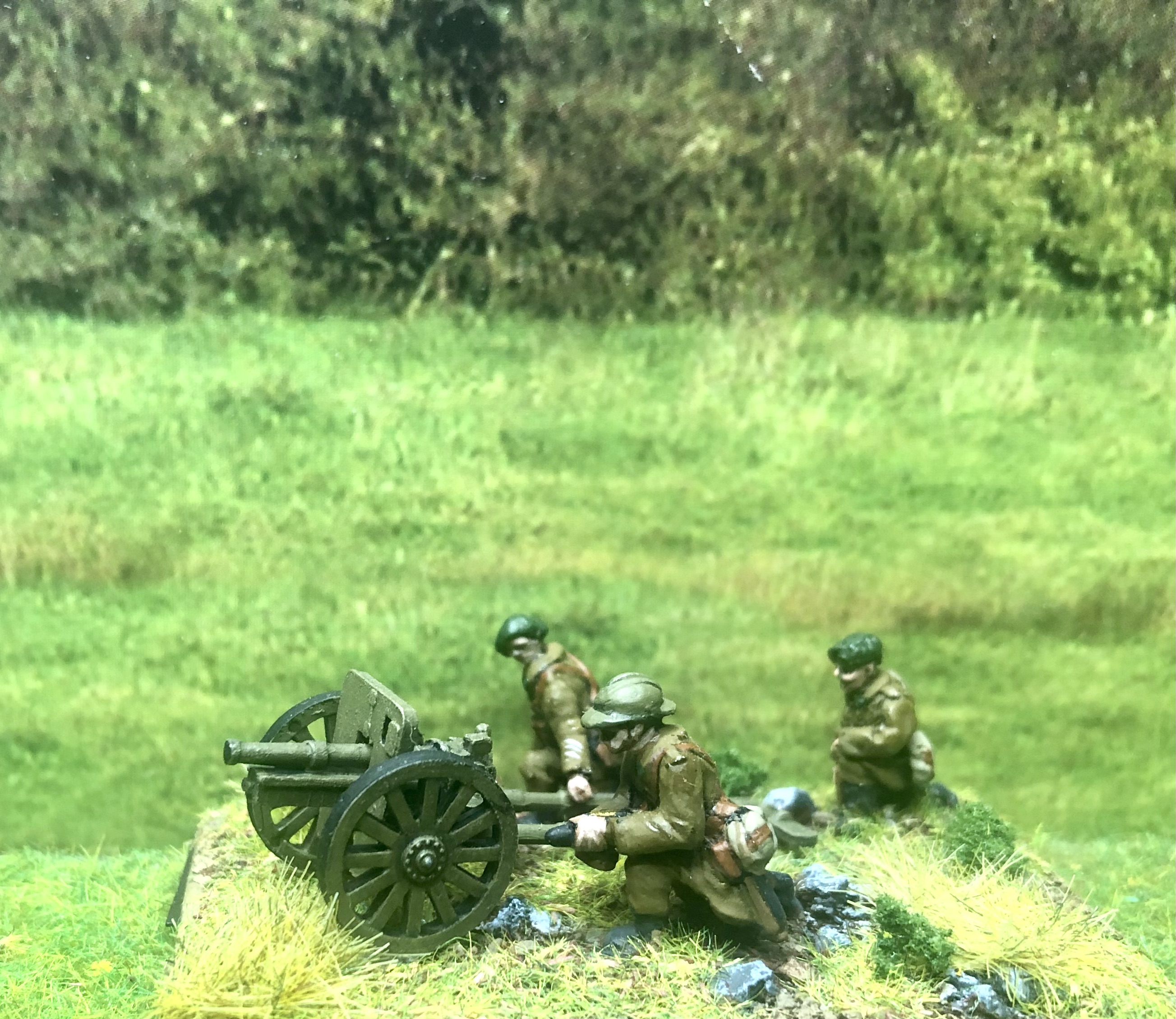
Cart pulled FRC C76mm gun


Vehicle towed C76mm FRC 


Friday, February 28, 2025

82nd Airborne Project - part 2 Supply Jeeps

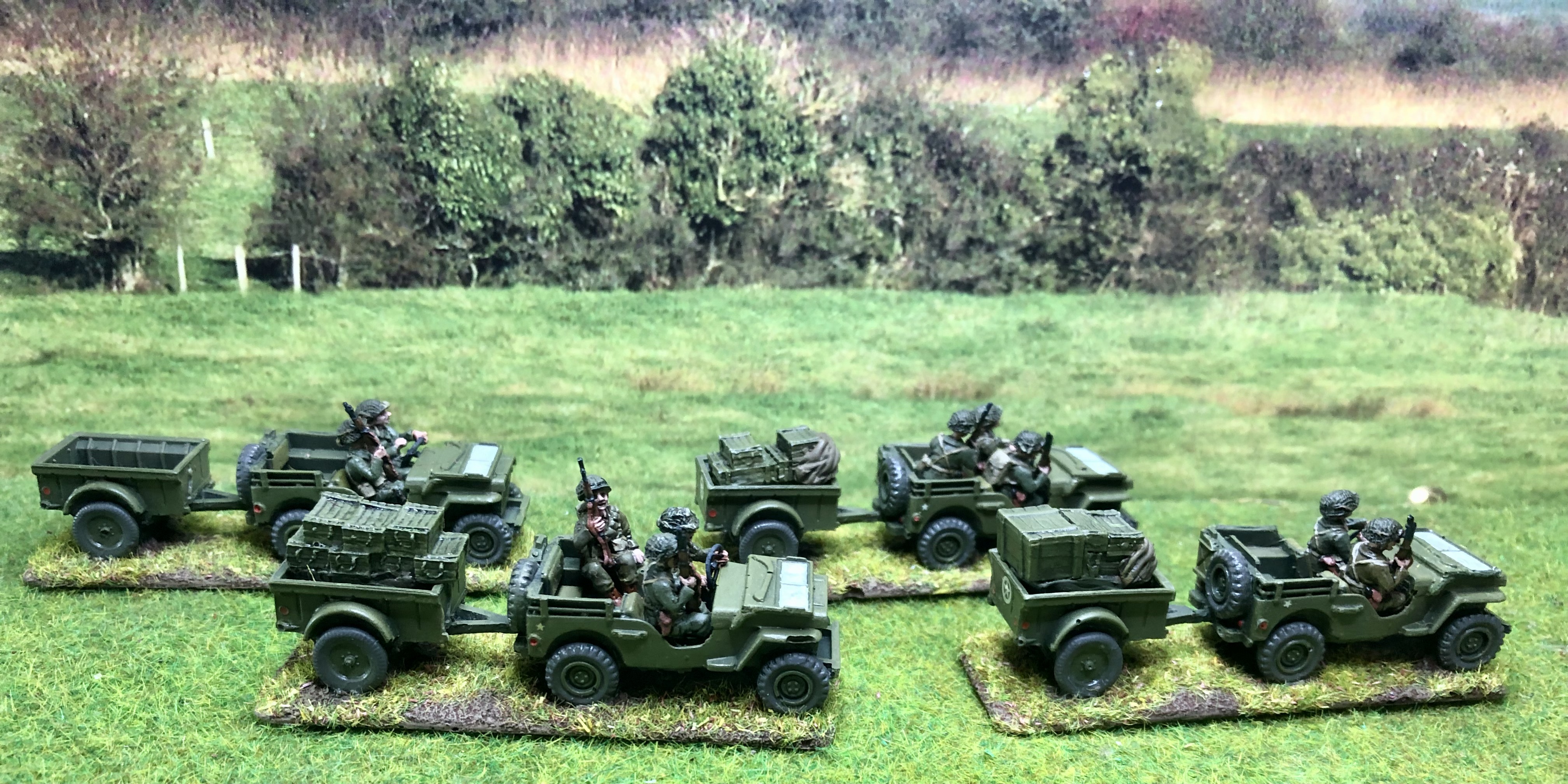
 82nd Airborne project part 2 - supply jeeps 

Off the desk this week some American airborne jeeps for my Arnhem collection, jeeps are Raventhorpe, crews are Alder, loads are a mix of SHQ and scratch built.


Cheers

Matt

Saturday, February 1, 2025

17th SS Götz von Berlichingen in Normandy & Pays de Loire part 1

 17th SS Götz von Berlichingen in Normandy & Pays de Loire 1944


Another upcoming winter project for the analogue painting challenge this year is to add the 17th SS Gotz von Berlichingen to my collection. I have commenced putting together some information for the division in preparation for my build. As with all of builds I will select some of the more useful units to build for my Normandy collection. The unit predominantly was filled with Volksdeutsche Balkan conscripts and 500 Italians who fitted the Aryan ideal with cadre of NCOs from the 10SS, the Der Furher 35th and 36th regiments supplied the Officer and senior NCOs cadre,  a bit of confusion with the division make up as some units became cadre for other SS units. 

Unit movements Normandy & Pays de Loire 1944


According to an order by Hitler dated 3 October 1943 the 17. SS-Pz.Gren.Div. was to be formed, a process that was begun on 15 November, south of Saumur at Thouars. The structure of the division was laid out 


Its manpower strength amounted to 17 321 men on 1 June, but it was short of 233 officers and 1 541 NCO:s, while it had a surplus of 741 privates. This meant that the division was short of about 40 % of its officers and NCO, a serious disadvantage. 

At the beginning of June the division had many deficiencies. The greatest was probably the lack of infantry and supply vehicles. The supply services of the division completely lacked transportation on 1 June. According to a report concerning the situation 15 May the division had only 257 trucks and towing vehicles of all types. No deliveries of JagdPz IV had yet occurred, but the 3. Kompanie of the had three 7.62 cm Pak R (Sf) and nine 7.5 cm Pak (Sf).

By using the Aufkl.Abt., StuG.Abt., SS-Pz.Gren.Rgt. 38 and one reinforced artillery battalion (consisting of four batteries with 105mm le.FH and one battery with 150mm s.FH a mobile Kampfgruppe was formed that moved to Normandy on the 6th of June. 
I will concentrate on this Kampfgruppe and 17th Jagdpanzer Panzer which fought only 20klm from my house. 

Weapon returns 

In June it had the following equipment

On Hand

Shortage

Machine Guns

1 008

146

8 cm mortar

99

0

7,5 cm le.IG

8

21

15 cm s.IG (Sf)

12

0

10,5 cm le.FH

25

0

15 cm s.FH

12

0

10 cm K

4

0

5cm Pak
7.5cm Pak
7.6 cm Pak
33
22
3

5

2 cm Flak

44

0

2 cm Flakvierling

7

0

3,7 cm Flak

9

0

8,8 cm Flak

12

0

Flamethrower

72

2

Motorcycles

275

410

Cars

1104

22

Trucks

245

1 441

RSO

2

0

Towing vehicles

10

245

Schtz SP & Pz Spah

61

0

Marder

12

0

StuG IV
StuG III (in late July) 
83
17
0
0

Bef.Pz III J, H and M

0

3 arrived in August

A disadvantage was the shortage of Panzerfäuste. According to Stöber the division did not receive any until mid-July and then only in insufficient quantities.

When they were transferred to the invasion front, the 3 companies of SS Panzer Division 17 each had 14 StuG IVs, a total of 42. These were delivered to the unit in February, March and April 1944. The division staff did not yet have any armored vehicles. Panzer Division IVs did not arrive until mid-August 1944.

Stabs Company with 2 Panzer Befwg. III, 6 Flakpz. 38 

1st - 3rd Company with a total of 42 StuGs
(the vast majority of which were StuG IVs, as I currently assume that all 41 StuG IVs delivered were taken over by the Panzer Gren Division - which already had this type) one StuG  III is also in images for July.

1st June 44, GvB had four Sd.Kfz. 231 8 rad A/C, fifteen 222 2cm and 221 mg, 42 StuG IVs, and 3 Panzer III H or J or M 5cm L60 guns. There is a pioneer zug in the Stabs Kp of the Panzer Abt. and this may have been equipped with Sdkfz 251/7 (There is one picture in the book of this vehicle with the HQ of the Pioneer Abteilung ). 

On 27 June all the six infantry battalions were still considered strong back lacking officers and Ncos. The Aufkl.Abt. on the other hand was rated to be weak.

At the beginning of June 1944, the SS-Pz.Jg.Abt. 17 was only represented by the 3rd Company in its division. It had 3 Panzerjäger 38 (t) for 7.62 cm Pak 36 (Sd.Kfz. 139) and 9 Panzerjäger 38 (t) for 7.5 cm Pak 40/3 Ausf. H. The majority of the 1. and 2./SS-Pz.Jg.Abt. 17 was still being set up and trained on the Jagdpanzer IV (7.5 cm Pak 39 L/48) (Sd.Kfz. 162) and remained in the previous assembly area near Saumur when the division left. 31 Jagdpanzer IV were then delivered on 30.6.1944. 

The SS-Pz.Jg. Abt. 17 with 12 Panzerkampfwagen 38, 2 cm Flak 38 (Sd.Kfz. 140) the SS-Pz.Jg.Abt. 17 marched towards Normandy on August 4th, 1944. On the orders of the AOK 7, however, it was deployed in the Laval - Le Mans area and was almost destroyed in a five days. Only 5 damaged Jagdpz. IV and 4 Flakpz. 38 arrived at Nogent let Rotrou 10 days later.

By August 15, 1944 , there were only about 5 Jagdpz. IV (all damaged), 5 StuG IV (all damaged), about 2 Marder III and 4 Flakpz. 38 remaining (two more Flakpz. 38 arrived in the following days). A few days later, the 3 Pz.Bef.Wg. IV arrived. The 5 StuG IVs had been given to a Pz.Werkst.Kp. in the Greater Paris area for repairs. It is not entirely clear whether they ever returned to the division. In the second half of August, 17 new StuG IIIg were delivered to SS-Pz.Abt. 17 in late July early August. It is not entirely clear whether they actually all arrived, however a photo in late July before operation Lüttich it seems at least one was in combat. If they did, most of them were lost again within a short time, because on September 15, 1944, only one StuG of an unspecified type was reported.

Movements

June 6 : Allied invasion, Normandy 
June 7 : operation Mimosa, orders for mobilization to advance to Normandy. The 17th aufklärungsabteilung, and a Kampfgruppe made up of 3 battalions move to Normandy immediately via vehicles, the remainder of the infantry on bicycles, the artillery move that evening. 
June 8: the reconnaissance battalion and the 38th battalion begin arriving at St Lo. Petrol supplies are low and many of the infantry battalions vehicles are destroyed on route by aircraft. 
The Self propelled guns and assault guns are loaded onto trains to move to Laval but are attacked by allied aircraft losing two vehicles one StuG IV and one SP gun, the trains unload at La Flèche short of  Le Mans, then drive to Laval - Fougéres - Avranches - Villedieu - Torigny to the Balleroy area
SS-Flak Abteilung 17 and SS-Pioneer Bataillon 17 move to Saumur to defend the five bridges across the Loire between Angers and Tours. 
June 9 : 17th SS Aufklärungsabteilung (reconnaissance) battalion in clashes with British 7th Armoured, and infantry on route to Bayeux and American armour and troops on route to Isgny-sur-mer, plus capture missed dropped parachutists. 
June 10 : 17th GvB subordinated to the 7th Army 
June 11 : 17th SS Aufklärungsabteilung, 17 SS-Panzergrenadierregiment 37 and elements of 6th Fallschirmjager Regiment Combat at Carentan against 101st Airborne and 2nd Armoured (Bloody Gulch)
June 11-12 Graignes combat between 182 men of the 506, 507 and 74th transport carrier squadron were assaulted by elements 17th SS 38 Regiment. The fighting is fierce however the numerically superior 17th SS overrun the village, they destroy and burn the village, executing 17 US Paratroopers and 11 civilians, the Us Paratroopers retreat into the wetlands around the village. 
June 12 : US paratroopers capture Carentan, SS regiment 37 III battalion counterattack against the American parachute units at Auvers.
June 13 : Carentan; unsuccessful counterattack by SS-Pz.g Regt 37 1 & 2nd battalion against the US 101st Airborne at bloody gulch. 
June 16 : SS-Brigadeführer Ostendorff WIA ; SS-Oberführer Eduard Diesenhoffer becomes division CO.
June 18 : SS-Kampfgruppen 1 & 3 become SS-Panzergrenadier Regt.s 49 & 51 respectively 
June 26 -27 : GvB counter attack at Méautis, south of Carentan, halted by US 4th infantry and 2nd Armoured., loss of three StuG IV.
June 30 : Division strength of 16,976 men SS-Kampfgruppe 3 strength: circa 2,900 
June 30 : 17 Pz. Jg. Abt receives 31 Jagdpanzer IV 7.5cm pak 39 L48 & 12 sdkfz 140 2cm flak 38 in Saumur, HQ Saumur Chateau.

July 1944 division strength at 8,500; 

3rd July units in reserve behind “ Mahlmann line”
6th July fighting around Saint Framond
7th July withdraws to the Perriers area and west of St. Lo by the beginning of July 1944
9th -21st July 38th Régiment fighting at Sainteny against 83rd infantry division. 
10th fighting around Pont-Hébert defending against 30th and 35th US infantry divisions. 
15th -24 July heavy fighting Perrier area against US 90th infantry division 
July 25 : US Army breaks through west of St. Lô. During Operation Cobra 
July 26th : GvB counterattack near Marigny against US 1st Infantry division and 3rd Armoured Division. 
July 27 : counter attack at Notre-Dame-de-Cenilly against Us 2nd Armoured and 4 infantry divisions breakthroughs.
July 28 : 7th Army AOK order withdrawal to Weisse Linie ” (“white line”) near Percy to prevent German units in the Cotentin peninsula being cut off. 
GvB Heavy fighting for the high ground around Cerisy-la-Salle overlooking Countances road vs US 3rd Armoured Division 
July 29 : US Army captures the bridges at Avaranches opening the route into Brittany. Elements of the Gotz von Berlichingen, along with units of the 91st Luftlande Division and 2nd Das Reich SS cut off and captured in the Roncey pocket. 
July 30 : 17 Pz.Jg. Abt receives movement orders for Operation Luttich, elements join 2nd SS for the operation. 

August 1944 : 

Aug 4: 17 Pz.Jg. Abt departs Saumur for Normandy.
Aug 4: 51st Regt. sent to Troyer, France 
Aug 4- 5th: 17 Pz. Jg. Abt arrives Laval after diversion by AOK 7 to defend Mayenne River crossing and airfield at Laval. 
August 6: Laval heavy fighting defending the city, fighting retreat towards Le Mans after breakthroughs north and south of Laval,, sacrificing the majority of the jagdpanzer IV defending the road to Le Mans (7th army HQ was in Le Mans)
Aug 6 : Kampfgruppe Fick prepares for the "Mortain Offensive" (a.k.a. Operation "Luttich") - the assault on Avranches to cut off Pattons 3rd army. The GvB kampfgruppe assigned to the 2nd SS-Panzer Division
August 7 : Operation Luttich launched at 3am with GvB in the vanguard. 
August 7: 17 Pz. Jg. Abt fighting retreat to Le Mans
August 8: Le Mans Captured, 7th AOK headqauters retreat north east to Chartres.  
August 9: remainder 17 Pz. Jg. Abt retreat towards Nogent Le Rotrou towards Chartres.
Aug. 10 : 49th Regiment reclasified as "26.SS-Panzer-Division" (originally named 25th SS Panzer Division by the SS-FHA before they realised that they had already given out the number to a SS division of Hungarian recruits) & 51st Regiment as "27.SS-Panzer-Division" (26th divsion?) - to confuse allied intelligence. 
Aug 11 : GvB kampfgruppe remnants given the order to retreat from Mortain towards Domfront. 
Aug 13 : 49th Regt. transferred to France; attacked by the Danish Resistence and Allied "Jabos" (fighter-bomber aircraft) the unit suffers heavy casualties and loses much of its equipment.
Aug 15 : Fighting Withdrawal commences.
 GvB split into 4 Kampsgruppe:
Kampgruppe Braune SS flak- Abteilung 
Kampgruppe Gunter SS Aufklärungsabteilung and elements of ost battalions 439 and 635. 
Kampgruppe Fick - SS-Panzergrenadier Regiment 37 and SS-Pioneer Abteilung 17 under SS-Obersturmbannführer Jacob Fick.
Kampgruppe Wahl SS-Panzergrenadier Régiment 38 under SS Hauptsturmfürhrer Kurt Wahl. 
Aug 16 : Regt. 49 arrives Calais. 
Aug 21: The division kampfgruppe then trapped in the Falaise Pocket. Only around 1,500 men in the division were able to escape to their own lines. First the men marched to Laigle, then to the Seine and to Meaux by August 25th.
Aug 28 : 1st Battery 17th SS Flak Battallion covers retreating German troops at Loire river bridge at Angers. 
Aug 22 : Regt. 49 transferred to Meaux
Aug 23 : Regt. 51 attacked by US 4th Armored Division, Troyes
Aug 25 : Regt. 51 remnants flee Troyes; unit subordinated to GvB (some accounts say this occured Sept 7-8); 49th Regt. combat Romilly; then retreats to Verdun
Aug 29 : remnants of GvB Panzerjager withdraw to Chartres forest for refitting.

Organisation Rapid Fire 

Commanding officer 

SS-Oberführer Werner Ostendorff (Janvier 1944 – 15 juin 1944)
SS-Obersturmbannführer Otto Binge (16 juin 1944 – 18 juin 1944)
SS-Standartenführer Otto Baum (18 juin 1944 – 1er août 1944)
SS-Standartenführer Otto Binge (1er août 1944 – 29 août 1944)

Stabs Kompanie Co, 2IC + 8, PKW car, radio truck, M/C combo, Sanits Kompanie sdkfz 251/8, sdkfz 7/1 20mm flak

SS-Panzergrenadier Regiment 37 : SS-Obersturmbannführer Fick 
17. stab Komp co + 5 radio, medic, 1 car, radio car, panzerschrek 1 M/C combo

I. Bataillon : Häussler Ertl OC + 5 radio, sniper, medic, panzerschrek Tartra car, light car
1 to 4 Kompanie 6 figs, MG, panzerfaust each, light French truck
II. Bataillon : Opificius OC + 5 radio, sniper, medic panzerschreck, light car 
5 to 8 Kompanie  6 figs, MG, panzerfaust each, cycles light French truck (civilian)
III. Bataillon : Zorn OC + 5 radio, sniper, medic, panzerschreck, light car 
9 to 12 Kompanie  6 figs, MG, panzerfaust each, cycles 
13. Kompanie :  1x IG 75mm 4 crew light truck, 2x 81mm mortar, 6  crew Steyr, 2 x MMG 6 crew 2 x MMG 6 crew light truck 
14. Kompanie (Flak) : 1x 20mm flak, light car 4 crew 
15. Kompanie (Pionier) : 6 figs mg, flamethrower light car
16. Kompanie (Aufklärungs) : 8 figs cycles 


SS-Panzergrenadier Regiment 38 :Horstmann 
17. Stab Komp co + 5 radio, medic, sniper, panzerschreck, 1 car, radio car, 1 M/C combo

I. Bataillon :  Ertl OC + 5 radio, sniper, medic,  panzerschreck, sdkfz 2 pkw
1 to 4 Kompanie 8 figs, MG, panzerfaust light French  truck
II. Bataillon : Nieschlag OC + 5 radio, sniper, medic, panzerschreck
5 to 8 Kompanie  6 figs, MG each, panzerfaust light French truck civilian 
III. Bataillon : Bolte Ertl OC + 5 radio, sniper, medic, panzerschreck
9 to 12 Kompanie  6 figs, MG each, panzerfaust  cycles 
13. Kompanie Sig 150mm 4 crew truck (MMG), 2x 81mm mortar, 6  crew, medium car 2 x MMG 6 crew light car 
14. Kompanie(Flak) : 1x 20mm flak, light car 4 crew 
15. Kompanie (Pionier) : 6 figs MG, flamethrower light truck
16. Kompanie (Auflärungs) :  8 figs 2x kubelwagens 


SS-Artillerie Regiment 17 : Binge, OC + 5 radio truck, VW  car 2 spotters, supply wagon, sdkfz 7/1 20mm flak
5 batterie  2 x SFH18m 4 crew horse limber per gun 
6 batterie 2 x SFH18m 4 crew horse limber per gun
8 batterie 2 x 150mm 4 crew tractor per gun 

SS-Panzerjäger Abteilung 17 : SS-Sturmbannführer Schuster 1 x PzJagd IV lang,  2 x flakpanzer 38
1. Kompanie : 2 x Pz Jagd IV lang (deployed in Pays de Loire)
2. Kompanie : 2 x PzJagd IV lang (deployed in Pays de Loire)
3. Kompanie : 1 Panzerjäger 38 (t) for 7.62 cm Pak 36 Ausf M, 1x Panzerjäger 38 (t) for 7.5 cm Pak 40/3 Ausf. H, 1 x pak 50 4 crew maultier.  (Deployed in Normandy)

SS-Panzer-Abteilung 17 : Kepplinger Befwg Panzer IIIM L50, 1 x sdkfz 7/1 20mm flak, sdkfz 250 radio and trailer, bergpanzer III, sdkfz  9 Famo, 
1. Kompanie : 2 x StuG IV
2. Kompanie : 2 x StuG IV
3. Kompanie : 2 x StuG IV
4. Kompanie : 2 x StuG IIIG
StuG IV had both nose types, predominantly in 3 colour camoflauge, with zimmeritt. 


SS-Flak-Abteilung 17 : SS-Sturmbannführer Braune
2. Batterie : 1x flak 88 tractor 6 crew, 1 x 20mm 4 crew tractor 
4. Batterie : 1x flak 37 tractor 4 crew.


SS-Panzer-Aufklärungs-Abteilung 17 Holzapfel
1 Kompanie 2 x Panzerspahwagen 2cm kwk 8 rad, 1 x 222 A/C
2 Kompanie 6 figs MG schwimmwagen
3 Kompanie 6 figs MG  schwimmwagen
4. Kompanie 8 figs MG and 81mm mortar 2 x  schwimmwagen 
5. Kompanie 4 figs, opel blitz truck pak 40


SS-Pionier-Bataillon 17  Fleischer OC + 3 light car, Sdkfz 251/7, panzerschreck 
1. Kompanie 6 figs mg flamethrower, panzerfaust
2. Kompanie 6 figs mg, Flamethrower, panzerfaust 
3. Kompanie 6 figs mg, flamethrower, panzerfaust 


Research resources 

Sarthe Août 1944 Histoire d'une libération, Fabrice Avoie 

Panzers Normandie 44 SS Panzer Abteilung 17, Götz von Berlichingen, S Cazenave & S Neuhaus

Gotz von Berlichingen Jean-Claude Perrigault & Rolf Meister
Normandy 1944 N. Zetterling 

Sunday, August 25, 2024

The Strivsvagen 103 Swedish army project

The S Tank 

Possibly the most recognisable cold war tank the Strivsvagen 103 or S tank. Work on improving the Strv S finally ended in March of 1966. A year later, in September of 1967, the tank was accepted into service. It received the index Strv 103, although Bofors documents kept calling it Strv S for some time. Ten years of work were not wasted: the army received an unusual, but technically excellent vehicle, ideally suitable for fighting in Scandinavia.


A big Cold War favourite of mine, I have six S Diecast tanks in my collection and one plastic with dozer blade, I have given them a repaint then gloss varnish, wash and weathered them so they all match. 

Photos to come! 

Cheers
Matt

Wednesday, August 21, 2024

16th Luftwaffe Field Division Normandy 1944


16 Luftwaffen Felddivision Normandy 1944


This year one of my main projects is to complete units for my Normandy Collection. The Luftwaffe field divisions tend not to be built due to there short history and poor fighting capabilities. The two Luftwaffe field divisions 16 and 17 were both roughly handled in Normandy during the fighting and were dissolved and broken up by the end of August 1944. I will be using SHQ Luftwaffe and Wehrmacht figures for the division, along with resin 1/76-1/72 vehicles and guns.


History 

The 16th Luftwaffe Field Division was formed on December 1, 1942 at the Groß-Born military training area. This resulted in the creation of the Luftwaffe Jaeger Regiments 31 and 32 of three battalions from lufwaffe ground staff with the average age of 38. The division also created Luftwaffe Artillery Regiment 16 with mixed pieces of anti aircraft and artillery assets. Additional units were added Luftwaffe panzerjager regiment 16, Luftwaffe Pioneer Battalion 16, an luftwaffe Reconnaissance Platoon, an Luftwaffe Intelligence Company and supply troops. The majority of the division was horse drawn.
In March 1943, the division, which had not yet been fully trained, was transferred to the Netherlands as an occupation force and took over coastal security in the Ijmuiden-Haarlem-Leiden-Scheveningen area in the summer of 1943 being a static division its infantry training was poor and had very few automatic weapons, the artillery regiment could only field three batteries at this time.

On November 1, 1943, the division was taken by the Wehrmacht, renaming it Field Division 16 (L). The division completed its restructure, creating Jäger Regiment 46 by taking the third battalions from 31 and 32 and adding a training battalion.

After the start of the Allied invasion of Normandy on June 6, 1944, the division commander, Lt. Gen. Sievers received the order on the 20th of June to move the division from Holland to Normandy. The division commenced road movement than rail then foot during the night by columns to the invasion front. 32 trains were used and no casualties were recorded.

At this time, the division had the following units:

Divisions-Nachschubtruppen 16 (L)

Fahrschwadron zug (L) HQ messenger
Kraftfahr-Kompanie (L) motor pool company
Nachschub-Kompanie 16 (L) supply company
Werkstatt-Kompanie 16 (L) workshop company

Verwaltungsdienste 16 (L)

Verwaltungs-Kompanie 16 (L) administration company
Bäckerei-Kompanie 16 (L) Bakery company
Schlächterei-Kompanie 16 (L) livestock slaughter company

Sanitätsdienste 16(L)

2 x Sanitäts-Kompanie 16 (L) medical company
Kranken-Kraftwagen-Zug 16 (L) ambulance platoon
Veterinär-Kompanie 16 (L) (Veterinary)

Divisions-Nachrichten-Abteilung 16 (L) intelligence

Stab Kompanie
1 & 2nd Kompanie 

Jäger-Regiment 31 (L)

Regimental Stab 
1st battalion 
Stab
4 companies 500 men 

2nd battalion 
Stab
4 companies 500 men 
MG and Mortar coy

Jäger-Regiment 32 (L)

Regimental Stab 
1st battalion 
Stab
4 companies 500 men 

2nd battalion 
Stab
4 companies 500 men 
MG and Mortar coy

Jäger-Regiment 46 (L)

Regimental Stab 
1st battalion 
Stab
4 companies 500 men 

2nd battalion 
Stab
4 companies 500 men 
MG and Mortar coy

16 Panzerjager Abteilung (L)

Stab

1. Kompanie (5cm PaK38 and 7.5cm PaK40) RSO tow
2. Kompanie (2 StuG III G) (8 more on the 8th of July)
3. Kompanie (twelve 2cm FlaK38) sdkfz 8 

16 Pioneer Abteilung (L) 

Stab
3 companies 378 men

16 fusilier battalion (L) cycles 

Stab
3 Jäger company’s 
1 machine gun company 406 men 

Feldersatz-Bataillon 16 (L)

Stab
2 companies 238 men

Artillerie-Regiment 16 (L)

Before the transfer, the 16th Artillery Regiment (L) was rearmed. The large 10.5 cm anti-aircraft guns of the 1st battalion was replaced with Russian 7.62 cm guns. The II. Battalion also handed over its French 15.5 cm guns and was equipped as follows:
1. Batterie (no guns)
2. Batterie 4 x 7.62 FK288(r) horse drawn
3. Batterie 4 x 7.62 FK288(r) horse drawn 
4. Batterie 4 x 7.62 FK288(r) horse drawn
5. Batterie (no guns)
6. Batterie 4 x 7.62 cm horse drawn 
7. Batterie 4 x 12.2 cm
8. Batterie 4 x 12.2 cm
9. Batterie 4 x 12.2 cm
(Munoz, Luftwaffe Field Divisions, p.255:)

Deployment Normandy 

From June 25th, the first parts of the division arrived in the Vimont area southeast of Caen ( Meyer, 12.SS, map p. 237). By July 16th, 1944, the last parts of the division had arrived at the front. According to OB West, Ia, TgbNr. 5197/44 gKdos v, 2,7,1944, the II./JgRgt 46 (L) and the I./ JgRgt 32 (L) were deployed (west of the Orne), while the I./JgRgt 46 (L) and the II./JgRgt 32(L) were prepared for deployment.


On the 5th of July three of the division infantry Regiments 31, 47 and 32 were deployed into the line taking up the 21st Panzer division positions east of the Orne estuary and joining 12th SS in the west. Taking up line positions from Hérouville- Lébisnay - and Hill 64 the railway line and road D60 to the coast being the divisions left flank. The replacement of the 21.PzDiv by the 16.LwFelddivision in the area north of Caen took place on 5.7.44 at 18:00. Parts of the 21.PzDiv remain in the positions, including I./PzRgt 22, PzJgAbt 200, parts of Sturmgeschütz-Abt. 200, II. and III./Art.Rgt 155 sited behind the ridge on the Colombelles road. Heavy tank regiment 503 was also to join the 16 Felddivision (L) line of defence on the night of 7th however due to the preparatory air bombardment did not join the division. (Wolfgang Schneider, Tiger in Combat - The Operations in Normandy, self-published Uelzen, 2004, p.93)

Operation Charnwood

Operation Charnwood began on the afternoon of July 7, 1944, with the British battleship "Rodney," which opened fire with its heavy 34.6 cm naval artillery from a distance of 25,000 yards and fired 28 salvos at Hill 64, 1.5 km north of Caen, a hill that dominated the position of the 16th Felddivision and was, in the British view, a key point of defense. The streets of Epron and Lebisey converged there and a wide street led to the city center and to the intact Orne river bridge.
Late in the evening of July 7, between 9:50 and 10:30 p.m., 450 enemy aircraft, according to other sources 467 British aircraft, dropped 2,300 tons of high-explosive bombs on the German defense lines north of Caen and around 11:00 p.m. two British artillery corps opened fire on the German lines. This extremely heavy artillery fire continued without interruption or lessening until the morning of the next day, when the British 3rd and 59th Divisions began the attack on the positions of the 16th felddivision. (Jagolski, Luftwaffe Division, p. 132, Munoz Luftwaffe Field Divisions, p. 257) This concentrated firepower had practically destroyed the 16th felddivision.
Within an hour, the British had achieved their partial objective of taking Lebisey and Heronville and continued their attack towards Point 64 and Caen. The British 3rd Division in the sector of the 16th Luftwaffe Field Division reported at 8:35 a.m. that it had completed its mission to clear the forest east of Lebisey. Le Bujude was also lost and the enemy was advancing on Epron.
At 9:00 a.m., Panzer Group West received a report from LXXXVI.AK that, after heavy air attacks and heavy barrage, the enemy had begun an attack in the area of ​​the 16th felddivision at around 6:00 a.m., had penetrated Lebisey with tanks and was advancing on Calix. The Commander-in-Chief ordered the deployment of the II. Battalion of the 21st Panzer Division to the division. This concentrated firepower had practically destroyed the 16th felddivision, all of the division's battalion commanders, whose battalions were deployed in the front line, had fallen and the division itself lost 75% of its total combat strength.
The British encountered only slight resistance from the 16th Felddivision (L), at around 4:30 p.m., the 3rd British Division had taken Hill 64 from the 16th Felddivision.
Ordered to withdraw east across the Orne at 19:15 on the 8th into the lines of the 21st Panzer Division and placed at Colombelles village, Colombelles Chateau and the Caen steel works south of the town. The division infantry regiments are said to have suffered 75% losses, around 375 men, crossed the river. (Jagolski, Luftwaffe Field Division, p. 132-133, 12th SS, p. 255, 257, 259, 260, 265). Colonel Hans von Luck, combat group commander of PzGrenRgt 125 of the 21.PzDiv, recalled that a battalions of the 16.Felddiv.(L) was placed under his armored combat group, while other battalions of this division were also said to have been under the command of PzGren-Rgt 125. (Munoz, Luftwaffe Field Divisions, p.257: Source Hans von Luck, Panzer commander, The memoirs of Colonel Hans von Luck, Praeger Publishers, Westport, 1989, p.169)

On July 9, 1944, eight StuG III were delivered to the 16th Felddivision (L).
(Munoz, Luftwaffe Field Divisions, p. 259: Deliveries of the armored vehicles BA-MA RH 10/349)

Panzer Group West attempted to reorganize its forces and improve and strengthen its defensive positions south of Caen. In the rear of the 16th Field Division (L), which the German leadership and its division commander, Major General Sievert, assumed would again be the main target of the British-Canadian attacks due to its losses and previous performance, anti-aircraft and armored units were prepared for counterattacks. (Munoz, Luftwaffe Field Divisions, p.260)
At around 5:30 a.m., the 3rd Company of the 503rd Heavy Panzer Battalion was alerted. After a short, heavy artillery barrage, enemy forces, British tanks and Canadian infantry, broke through the HKL between Cuterville and Colombelles and took possession of the high ground north of the Colombelles factory complex.
The 32nd (L) Jäger Regiment battalion strength retreated to Cuterville, leaving the enemy open to Giberville and the area east of Caen. (Schneider, Tiger in Combat – Normandy, p. 100, map p. 102)
On July 15, 1944, the last parts of the 16th Field Division (L) arrived at the front, about 2,400 men who were immediately distributed across the thin front lines.
Although the LXXXVI.AK, Panzer Group West, nominally had four divisions in mid-July 1944, the 21st Panzer Division, the 346th and 711th Infantry Division and the 16th Field Division (L), it only had the strength of a reinforced division, since each of these divisions could only be considered a combat group. The only reasonably operational unit was the heavy tank (Tiger) unit 503, which was directly subordinate to the corps. (Munoz, Luftwaffe Field Divisions, p.260, 268: Munoz incorrectly mentions the Schw.SS-PzAbt 103 here, which was not deployed in Normandy at this time because it still had no tanks, see also R.Pfeiffer, Zur Geschichte der s.SS-Pz.Abt 103/503)

On July 15, 1944, the commander of the HGr.B, Field Marshal Rommel, traveled to the Orne area in the afternoon in anticipation of a major enemy attack and visited the 346th Inf Div, the 16th Field Div.(L) and the 21st Panzer Div one after the other. He had the leaders report on the situation and structure of the units. Details of the measures to defend against the major attack were discussed. (Schneider, Tiger in Combat - Normandy, p.105)
In front of the field bridgehead east of the Orne lay under the command of Panzer Group West: LXXXVI.AK with
  • 711.InfDiv 
  • 346.InfDiv in the sector Franceville-Pl. to north of Touffreville 
  • 16.Felddiv (L) in the sector north of Touffreville, to Colombelles chateau with subordinate Panzergrenadier Regiment 192, 21.PzDiv, on the left to the Orne bridge in Caen.
The focus of the impending enemy attack was to be expected in the sector of the 16th Luftwaffe Field Division, Division Command Post Argences, which had suffered heavy losses in the fighting for Caen. Therefore, not only was the 192nd Panzer Grenadier Regiment of the 21st Panzer Division subordinated to it and inserted on the left wing, but the bulk of this division and other units were deployed in the depths of the main battle area.
The front parts of the 16th Luftwaffe Field Division only formed an infantry veil, since
previous experience had shown that a dense garrison could hardly withstand the barrage of enemy artillery any better. Behind them was the combat group von Luck, according to the commander of the 125th Panzer Grenadier Regiment, 21st Panzer Division, Lt. Colonel von Luck, in several farm strong points.
II./125 in the Touffreville - Emiéville area,
I./125 in the Cuverville - Giberville - le Mesnil Frémentel - Démouville area
and StuGeschAbt 200 with 5 Bttr to 6 Pak 7.5 cm long and 4 howitzers 10.5 cm on "Hotchkiss" chassis.
To support this combat group, I./PzRgt 22 (Pz IV) and the heavy
PzAbt 503 (Tiger) were in the Sannerville - Emiéville area.
Further south, on the ridges of Bourgebus, PzAA 21 and PzPiBtl
220 were deployed to protect the artillery positions of the 16th Felddivision and 21st PzDiv artillery behind them, as well as the Luftwaffe heavy anti-aircraft batteries
.

The LXXXVI.Ak was in charge of the 9th nebelwerfer brigade. A total of 194 artillery guns and 272 mortars with 1632 tubes were used. In addition, 78 Flak 8.8 and 12
other heavy anti-aircraft guns. (12.SS, p. 274-275)

On July 17, 1944, the Jg.Rgt. (L) 32 was deployed north of Caen alongside the Pz.Gren.Rgt. 192 of the 21.Pz.Div. At this time, the I./32 was the only Regiment in the division that was still fully operational.

Behind the 16th Felddivision and the 272nd Infantry Division deployed at the front are the intervention reserves of the 21st Panzer Division and the heavy Panzer Division 503. In the deep zone, the 78 x 8.8 guns of an anti-aircraft division have taken up position (anti-aircraft and anti-tank defense) (LAH, p. 160)


Operation Goodwood 18.07.1944 

The British and Canadians continued the clearing of the Caen city east area with Operation "Goodwood" from the bridgehead east of the Orne at Ranville and from the Canadian positions on the edge of the city. Once again, the position of the 16th Felddivision (L) was in the middle of the target of the Allied bombers and attack aircraft. The enemy air attack, artillery and battleship fire pounded the German positions without interruption for two and a half hours.

Shortly before 5:00 a.m., the heavy infantry artillery opened fire on the identified anti-aircraft positions. During the next 45 minutes, 3,200 tons of bombs rained down on the position divisions, the 16th Air Forc Field Division and parts of the 21st Panzer Division.
As the heavy bombers took off, the heavy naval artillery from HMS "Roberts", "Mauritius" and "Enterprise" as well as the artillery from three army corps began to cover the identified or suspected German artillery positions with fire. The pounding lasted until 7:35 a.m., then the infantry attack divisions moved through the heavy dust clouds that had been thrown up.

When the medium bombers of the 9th US Air Force arrive at 7:00 a.m., a large part of the targets cannot be seen through the dust, so that some of them turn back. However, the fighter bombers and fighters attack the entire depth of the main battle area.
At 8:30 a.m., the 8th US Air Force attacks the area southeast of Frénouville and Bourguébus-Hubert Folie-Grentheville with Liberators in several waves until 9:30 a.m.
(LAH, p. 165, see also map no. 1, 28.-30.6.44, map no. 4 18.-21.7.44, see also Schneider, Tiger in Combat - Normandy, map p. 106)


The remaining parts of the 16th Field Division (L) infantry regiments were in the front line in the area south of St. Honoriene and Escoville back into Collombelles in a loose L shaped line of defence. The attacking enemy infantry units and tanks broke through the thinly manned positions of the 16th Felddivision (L) and the strong points just behind it. Strong resistance was only offered by the 21st Panzer Division and various SS units. Anyone who had not been killed or wounded could no longer think of resistance after the terrible bombardment and the effects of the firestorm. The heavy weapons, especially the anti-tank guns, were destroyed. The resistance of a few courageous soldiers was almost ineffective against the vast mass of 200 tanks that rolled over them.
The remnants of the 16th Felddivision were simply overrun and were largely destroyed by the enemy's material superiority, as they had not been able to break away from the fiercely pressing enemy in time.
(see also Jagolski, Luftwaffe FD, p. 133, 12th SS, p. 277 ff.)

All regimental and battalion commanders as well as 36 company commanders were out of action as a result of these two blows. The 16th Field Division (L) had ceased to exist. The major British attack began at 7:45 a.m., closely supported by direct artillery fire support. The British advanced from their position east of St. Honorine with the 159th Infantry Brigade of the 11th Armd.Div. The fighters of I./Jg.Rgt 46 (L) only offered isolated resistance.
(Schneider, Tiger in Combat – Normandy, p.115, see also map p.114)

At around 8:30 a.m., Panzer Group West received the first reports of "heavy barrage and bombing on the eastern Orne bridgehead near Colombelles in the 16th Luftwaffe Field Division's sector." The LXXXVI.AK also reported "about 100 enemy tanks from St. Honorine to the south."

On the Orne, I./JgRgt 32 (L) initially held up the 9th Canadian Brigade at the Chateau of Colombelles, and they even withdrew suddenly. An air raid at 13:00 was the explanation, but it had no effect, and the defended chateau was not hit either. Only after the entire artillery of the 3rd Cand. Div. had barraged the chateau, causing fires to break out, did they have to abandon it at 15:15. (Schneider, Tiger in Combat – Normandy, p.125)Attack against the 21st Panzer Division with remnants of the 16th Field Division (L) Battle for Mondeville, remnants of the 31st and 32nd Jäger Regiments return to the 12th SS Panzer Division, deployment of the 21st Panzer Division in the combat area of ​​the 16th Luftwaffe Field Division
(Author's note: The "Goodwood/Gut Holz" offensive was so unique in terms of its material expenditure that it is still the subject of so-called "Battlefield Tours" by the British "Staff College" every year (1980s), whereby this offensive is analyzed again and again together with German guests because the enormous material impact of that time, 2077 bombers with a carpet of bombs of 8,000 tons and the enormous barrage of artillery fire, had the effect of a tactical nuclear strike and is therefore studied again and again)

"Goodwood" did not bring the enemy the success they had hoped for after these preparations. Combat groups, especially the 200th Assault Gun Division, stopped the force of the attack, in the evening the 1st SS Panzer Division arrived, and later parts of the 12th SS Panzer Division. But after two days of heavy fighting the enemy had lost 469 tanks.

2. LwPiBtl. 16 On 11.07.44, battle day in Colombelles/Caen
8./LwJgRgt 46 on 18 July 1944, action in Demouville
The successor of Hptm. Hrantschnig as battalion leader of the I./LwJgRgt 32 was Oblt. Koschwitz, who was killed on 18 August 1944.
Kampfgruppe Johann: Oberst Dr. Edgar Johann RgtKdr LwJgRgt 31


19.07.1944
During the night of 18-19 July 1944, the 21st Panzer Division received orders to completely relieve and integrate the remnants of the now disbanded 16th Field Division (L), just under two battalions and an anti-tank platoon, and to set up a new HKL. Smaller parts of the 16th Field Division (L) were transferred to its right-hand neighbour, the 346th Infantry Division. However, the 21st Panzer Division received around 1,500 replacement men as a result of these measures.

The only exceptions were a portion of the remaining artillery, which was handed over to the 711th Infantry Division, as well as the communications troops, the supply units and the officers of the 16th Luftwaffe Field Division. These units were initially deployed in the rear area and later formed the core of a newly formed 16th Volks Grenadier Division. (Schneider, Tiger in Combat - Normandy, p. 127)

The division was finally destroyed between July 18th and 25th, 1944, according to the OKW between July 23rd and 25th.
It lost approximately 2,500 dead, wounded and prisoners between July 1st and August 3rd, 1944.


After an attack by the 21st Panzer Division in the Bois du Homme, east of St. Martin, which failed with very heavy losses, the KTB of the Panzer Gr. West noted on 1.8.44, 19:20 (or 19:30): "The attack by the 21st Panzer Division could not prevail because the troops assigned by the 16th Luftwaffe Field Division did not meet the requirements..."The remnants of the division, stragglers of the infantry, were integrated into the 21st Panzer Division and the 346th Infantry Division.
The staff of the 16th Luftwaffe Field Division and the baggage train etc. were combined with the 158th Reserve Division and thus formed the 16th Infantry Division, newly formed as part of the 30th Wave, which became the 16 Volksgrenadier Division in October 1944 and which was later involved in battles with American units in the Moselle Valley in France.

Sources

Goering's Grenadiers: The Luftwaffe Field Divisions, 1942-1945, Munoz
Tiger in Combat - Normandy, W. Schneider
Grenadiers, Kurt Meyer