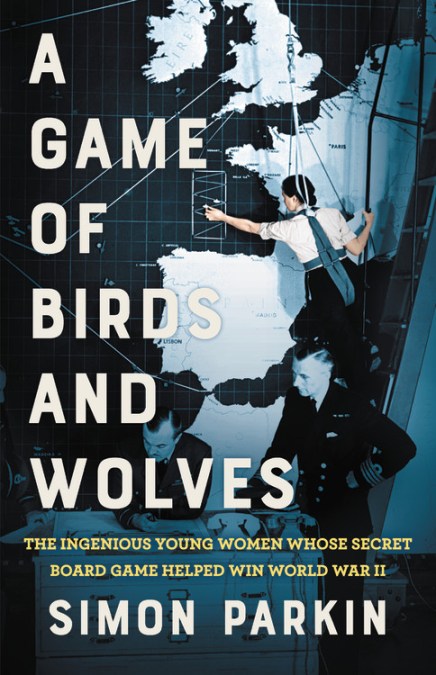
A Game of Birds and Wolves, Simon Parkin
How wargaming won the battle of the Atlantic
I spotted this book on an article back in February and put it on my wishlist, last month I decided to pick it up, what a revelation it was. I would encourage anybody who is interested in the war of the Atlantic to pick it up. Not many Wargame books relating to there real use in wartime are available, this was an interesting and positive view of our hobby.
The book is focused on the Western Approaches Tactical Unit or W.A.T.U and its unique use of wargames to train escort fleet commanders and officers about anti submarine warfare. The commander of the unit was Gilbert Roberts, a medically retired Naval Officer, who returned to service in 1941 to raise the unique unit. Roberts was a avid Naval wargamer (and is said to have played in Winston Churchill's group of wargamers) in the late 20s and thirties and he developed naval wargame rules very much influenced upon the rules of Frederick Jane (Naval War Game 1906) and the Royal Navy's Wargame rules of 1921.
In January 1942, Gilbert Roberts arrived at Derby House Liverpool, for a meeting with his new commander, Admiral Sir Percy Noble . Roberts explained to Noble that he would develop a game that would enable the british to understand why the U-boats were proving so successful in sinking the merchant fleet, and he would develop facilitate the development of counter tactics. Noble was dismissive of the new WATU section "Well, Roberts, you can carry on but don't bother me with it". WATU were given the entire top floor of derby House for the purpose of setting up the training facility.
The Western Approaches Tactical Unit Sign on the door, note the chessboard in the centre
One of WATU’s first tasks was to recreate a battle from a few weeks earlier, in December 1941, in which the convoy HG.76 consisting of 32 merchantmen and the 36th Escort Group (Cdr Walker consisting 2 sloops Depthford and Stork, and 7 corvettes : Rhododendron, Marigold, Convolvulvus, Penstemon, Gardenia, Samphire and Vetch. A support group consisting of the escort carrier Audacity (Cdr MacKendrick) and the escort destroyers Blankney, Exmoor and Stanley.) had successfully hunted three U-boats for the loss of . Roberts and his team believed that this, the battle for convoy HG.76, held the secrets they were searching for. The team arranged 48 ships in 12 columns. Then they added the tracks of the 12 U-boats known to have participated in the battle Historically the actual wolfpack only consisted of 10 U-boats U-67 (Korvkpt Müller-Stöckheim) *, U-107 (Kptlt Gelhaus), U-108 (sunk)(Korvkpt Scholtz) *, U-131 (Korvkpt Baumann ), U-434 (Kptlt Heyda ) U-71 (Korvkpt Flachsenberg), U-125 (Kptlt Folkers), U-567 (sunk)(Kptlt Endrass) *, U-574 (sunk)(Oblt Gengelbach ) *, U-751 (sunk)(Kptlt Bigalk). *fired torpedo or fired deck gun.The multi day contest involved 12 members of the team. The convoy models, were spread across six white lines on the floor to represent its six-mile width, in two-minute intervals and at a simulated rate of ten knots. Each move was made in precisely the same pattern as the actual escort a few weeks earlier. Blow by blow, Roberts imitated the action, as per the official reports. Seeing the battle from a crow’s-nest perspective above the board, a question formed in his mind. If the U-boats were firing from outside the perimeter of the convoy, as was widely believed, how had the Norwegian Merchantman Annavore, which was in the centre of the convoy, been sunk? Might it be possible, he wondered, that the U-boat had attacked the ship from inside the columns of the convoy?
There was, he reasoned, a simple way to prove his theory. “Hold everything,” Roberts told his staff, as he rushed into his office to make a phone call to his old friend, Captain Ian Macintyre. To Roberts’ astonishment, the flag officer himself, Admiral Sir Max Horton, picked up. Roberts explained who he was and asked Horton if he might be permitted to ask a question. During the last war, Roberts asked, would you ever have crept among the ships of a convoy to fire a torpedo? “Of course,” replied Horton. “It is the only way of pressing home an attack.” “Thank you, sir,” said Roberts, then hung up.
It was late, but Roberts asked Jean Laidlaw, a 21-year-old Wren responsible for statistical analysis, and one of the younger Wrens, Janet Okell, to stay behind with him to reset the plot and run a new game on the giant board. They hurriedly reset the game. This time, Roberts placed a U-boat model in the center of the columns of the convoy and ran the events of the battle in reverse. If the range of its torpedoes was around two and a half miles, it was reasonable to imagine that U-boat captains would fire from less than half that distance, in order to maximize their chances of scoring a direct hit.Between them, Roberts and the Wrens began to plot different scenarios that might have enabled the U-boat to sneak into the convoy without being detected. Only one checked out: the U-boat must have entered the columns of the convoy from astern. And it must have done so on the surface of the water, where it was able to travel at a faster speed than the ships it pursued. By approaching from astern, where the lookouts rarely checked, the U-boat would be able to slip inside the convoy undetected, fire at close range, then submerge in order to get away. The group discussed how if they were a U-boat captain having made a point-blank-range attack on a merchant ship, they might attempt to escape unharmed. The game had enabled the fledgling tacticians to think like U-boat captains, and from that perspective the answer suddenly seemed obvious: having made your attack, you would of course dive. Then you would sit and wait for the convoy to roll overhead.
With the U-boat tactic abruptly unveiled, Roberts then wanted to try out the commander Walkers "buttercup" anti submarine maneuver that had successfully sunk one of the submarines. The team worked out his maneuver had accidently sunk the U-Boat and actually was counterproductive to the protection of the convoy.
Returning to the game Roberts assumed the role of the U-boat captain, and Laidlaw and Okell played as the escort ships. Rather than splay out from the convoy at speed, dropping depth charges at random, as per the buttercup plan, Laidlaw and Okell lined the escort ships up around the convoy. While the convoy continued on its way, each escort ship performed a triangular sweep, listening for U-boats. They immediately picked up the position of the attacking U-boats. Roberts left the simulation excited that night.
The Raspberry maneuver that become the primary anti submarine maneuver
The next morning Roberts invited the skeptical Admiral Percy Noble to watch a demonstration of their findings. Noble entered the game room flanked by his staff. The commander-in-chief warily eyed the chalk markings on the floor, and the canvas sheets decked out like ship portholes. Roberts began to explain their discoveries — how the U-boats would slip between the convoy ships on the surface of the water, at night, when they were unlikely to be spotted, make their attacks, and then dive to wait until danger had passed.
But as the game played out the Admiral began to sit forward in his chair in astonishment. One of the Wrens, playing as a U-boat, fired a torpedo from within the convoy’s columns, then dived. Roberts performed the team’s newly developed counter-tactic, moving the escort ships in triangular sweeping patterns designed to flush out the hidden U-boat. While performing the sweeps, one of the escort ships “picked up” the Germans’ position on its radar.
As he watched Noble saw, for the first time, the cardinal errors that had been responsible for such tremendous loss of life at sea. When the demonstration was finished, the Admiral stood to his feet, congratulated Roberts and asked what the maneuver was to be called. Wren Laidlaw explained that she had christened it Raspberry, as a razz of contempt aimed at Hitler and his U-boat fleet.
The commander in chief then turned to one of his men and told him to take down a message to be sent to the Prime Minister. “The first investigations have shown a cardinal error in U-boat tactics,” he said. “A new, immediate and concerted counter-attack will be signaled to the fleet within 24 hours.”
The Training
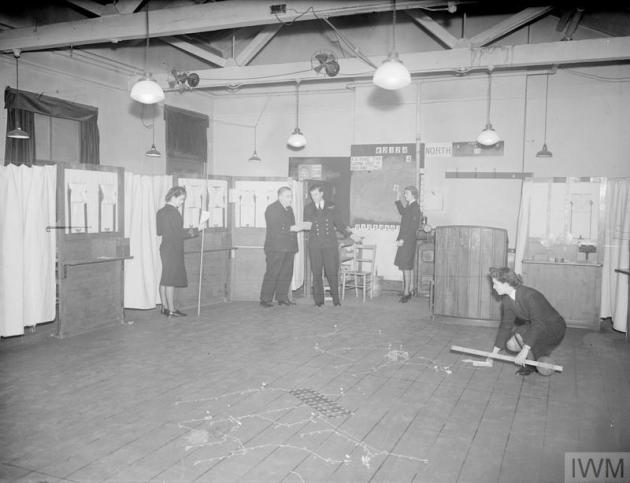
Using the floor as a giant board, the teams simulated a wolfpack attack on a convoy in the Atlantic. One team would play as the escort commanders, the other as the U-boat captains. Each team would take turns to make their moves, firing torpedoes, dropping depth charges etc, the U-boats diving and surfacing to make their attacks, the escort ships wheeling around in great arcs hunting the U-boats. The first day games were based on real engagements that occurred at sea to allow participants to learn why the escort commanders act the way that they did, and whether they might have lost fewer convoy ships and sunk more U-boats had they done things differently.
U boat commanders moving the hunters
The screens with the Wrens moving the convoy escorts as per the instructions of the officers

The officers had the opportunity to glimpse to movement of the convoy marked in white chalk, the submarines were marked in green, which they could not see because of the red filter used on the viewing peephole, the officer then plotted their maneuver on a chart behind them.
I plan to produce some Naval ww2 anti submarine wargames for our Wargame holidays in the future, and I am looking at the original 1921 Royal navy wargame rules which are now available to purchase. I suggest if you have some time and are interested in the atlantic campaign to pick up the book.
A Game of Birds and Wolves: The Ingenious Young Women Whose Secret Board Game Helped Win World War II by Simon Parkin, available now from Little, Brown and Company
cheers
Matt