Pages

Showing posts with label Yom Kippur 1973. Show all posts

Tuesday, August 19, 2025

Royal Moroccan Air Force - 1956 -1980

Royal Moroccan Air Force  - 1956 -1973


Summer is almost done and I finally get a few weeks off to complete models and do some airbrushing after one of the busiest Wargame holiday and b&b breakfast holidays .

I often do some resorting this time of year and come across partly complete projects in boxes. One of these was a F5A that I commenced earlier in the year during mad March, I was waiting on transfers to complete the model for my Royal Moroccan Air Force collection, these arrived this week.

The Moroccan Air Force was formed in 1956, its first aircraft were six ex French Morane-Saulniers MS 500 and three Max Holste MH1521 Broussard transport aircraft. In 1961, the Royal Morrocan Airforce gained the Royal title prefix. Its first purchases were twelve Mikoyan-Gurevich MiG-17 fighters, two Mikoyan-Gurevich MiG-15UTI trainers and two Ilyushin Il-28 bombers from the Soviet Union. Eight Fouga Magister training aircraft were also purchased from France. In 1962, 10 Douglas C-47 Skytrain and six Fairchild C-119G transport aircraft were purchased along with 12 North American T-6 Texans were used for pilot training, eight T-6Gs and 56 SNJ-4s had been delivered by France, but most of the airframes were in a very poor condition, and written off soon after their delivery for spare parts. 15 Harvard MkIV were also delivered in 1962 from ex Canadian stock. Several DO-28 SkyServant reconnaissance and light transport/liaison aircraft were also purchased from Germany

A political rift with the Soviet Union during the Sand War with Angola and this pushed Morocco to seek a new ally in the United States.  latter six Northrop F-5 combat aircraft (4 single-seat F-5A and 2 two-seat F-5B) and another 20 F-5A and four F-5B in 1966. 

At that time, the helicopter fleet was composed of six Aerospatiale Alouette IIs and four Bell 47s.
Starting in 1968, Morocco acquired 60 Bell AB205, 25 Bell AB206, two Bell AB212, and nine Bell CH-47C helicopters from Italy. Deliveries lasted until 1977.

The next modernization of the Moroccan Air Force took place just before the Sahara conflict. The first 25 Mirage F1CH fighters were purchased in 1975, together with 38 Aerospatiale Puma helicopters. Six C-130Hs were bought in 1973, and deliveries started in 1974. Modernization of Northrop F-5 Freedom Fighter with improved technology and the purchase of 24 Alpha Jet E would later be undertaken by the RMAF. 16 F-5Es and 4 F-5Fs were acquired in October 1979.  Morocco purchased four single-seat Northrop F-5s and two two-seat bombers from the United States. This deal was followed by another to purchase 20 F-5 attack aircraft and four F-5 bombers. Together with the F-5E/Fs, the FRA decided to buy a total of 24 OV-10As from the United States Marine Corps. However, only the first six aircraft were delivered. They were mostly used in a maritime patrol role and for reconnaissance due to their ineffic iency in combat.A total of 30 Mirage F1CHs were received in December 1979. Additionally, 20 Mirage F1EHs (including six equipped with in-flight refuelling probes) were delivered between December 1979 and July 1982. in 1982, a Boeing 707-138B was fitted with Beech hose units at the wingtips for refueling. Two Lockheed KC-130Hs were also delivered, and all of the F-5Es were modified with aerial refueling probes. four refueling aircraft were purchased, including three B-707s and one C-130

Sand War


The RMAF participated in the Moroccan-Algerian border conflict in 1963 known as Sand War. Its Fairchild C-119s and Douglas C-47swere used to resupply troops, North American T-6s for reconnaissance, and Morane-Saulnier Alcyons for ground attack. MiG-17s were only used sporadically, mostly due to their short range.

Yom Kippur War


I cannot confirm completely that the air force fought in any combat sorties, however reports of fourteen Mig 17 and twelve Moroccan Air Force Northrop F-5A joined the Egyptian 69 Squadron at Tanta on 19 October 1973. In January 1974 two F-5As armed with AIM-9Bs and 20mm cannons intercepted a pair of Israeli Air Force Mirage IIICJs on a reconnaissance mission. The Israelis turned away once the F-5As were detected, dragging both RMAF fighters behind them. Concerned about a possible ambush by Israeli F-4E Phantom IIs, the Egyptian Air Force ground control ordered both Moroccan fighters to return, replacing them with two EAF MiG-21MFs. The air force continued to fly missions over the Nile delta after the ceasefire.


Western Sahara War


At the beginning of the Western Sahara War, Fouga Magisters (based at Laayoune) and North American T-6 Texans (based at Dakhla) were used for ground support. Later on, the F-5s went into action, to strike POLISARIO targets.

In 1980, construction of the Sahara defensive walls began, consisting of several types of obstacles for infantry and armoured vehicles, such as mine fields and barbed wire. Radars and other electronic sensors were used to detect infiltration attempts, all backed by Quick Intervention Units (Détachements d'Intervention Rapide) able to move to and quickly reinforce attacked outposts along the wall.  It was also decided to use Aérospatiale SA 342 Gazelle helicopters with HOT missiles to engage the POLISARIO armoured vehicles and technicals from outside the range of light anti-aircraft guns. Apart from the ground radars of the Wall, two C-130 Hercules equipped with SLARs were also used for the detection of enemy units. However, the first portion of the wall, completed in 1982, protected only the area considered as “useful” for Morocco's political and economic interests, that is, the capital Laayoune, the religious center Smara, and the phosphate fields of Bou Craa.

After the loss of nine F-5As during combat operations against the POLISARIO, 16 F-5Es and 4 F-5Fs were acquired in October 1979. The main problem that faced Moroccan fighter-bombers in Western Sahara was their insufficient range over the vast battlefield of the Sahara desert.

In December 1977, the Royal Moroccan Air Force started receiving its first Mirage F1CHs. Even though the Mirage F1CH was designed as an interceptor, it was used almost exclusively for ground attack in the war against the POLISARIO. The last of a total of 30 Mirage F1CHs were received in December 1979. Additionally, 20 Mirage F1EHs (including six equipped with in-flight refuelling probes) were delivered between December 1979 and July 1982.

With the outbreak of the Sand War, the Soviet Union betrayed an ally it could have had—Morocco—by supporting Algeria, given its socialist approach. Instead of balancing its relations with both countries, Morocco shifted its focus to a new ally: the United States.


As for transport units, 10 of the famous Douglas C-47s, 18 Fairchild C-119Gs, and six C-130 Hercules were acquired . Due to the conflicts in the Sahara, Morocco saw a need for helicopters, and therefore purchased 24 Augusta-Bell AB205A helicopters. For training, the needs were covered by 60 T-6 ​​Texans. The subsequent development of the air force was through the acquisition of Mirage F1 attack aircraft. Given the importance of the air force and the difficult period it went through and its reliance on aviation, more pilots needed to be trained. Therefore, T-34 Mentor trainer aircraft were acquired, along with the purchase of Puma helicopters and an unspecified number of C-130s to replace their aging counterparts.
Morocco needed aircraft to monitor its long coastline, and after studying the matter, a deal was concluded with the United States to purchase six OV-10 Bronco reconnaissance and attack aircraft.

With the outbreak of hostilities between Morocco and the Polisario Front, Morocco needed light armor-piercing helicopters. This was accomplished by purchasing an unspecified number of Hughes 500MDs, equipped with TOW missiles, which destroyed several T-55/54 tanks and BMP armored vehicles.
To track enemy units, Morocco purchased C-130 aircraft equipped with the SLAR system to track enemy units. It also gifted the Shah of Iran two RF5 reconnaissance aircraft, followed by a significant deal for 20 new F-5 Tiger II aircraft.



Tuesday, April 29, 2025

Battle of Serabaeum October 1973

Battle of Serabaeum October 1973 

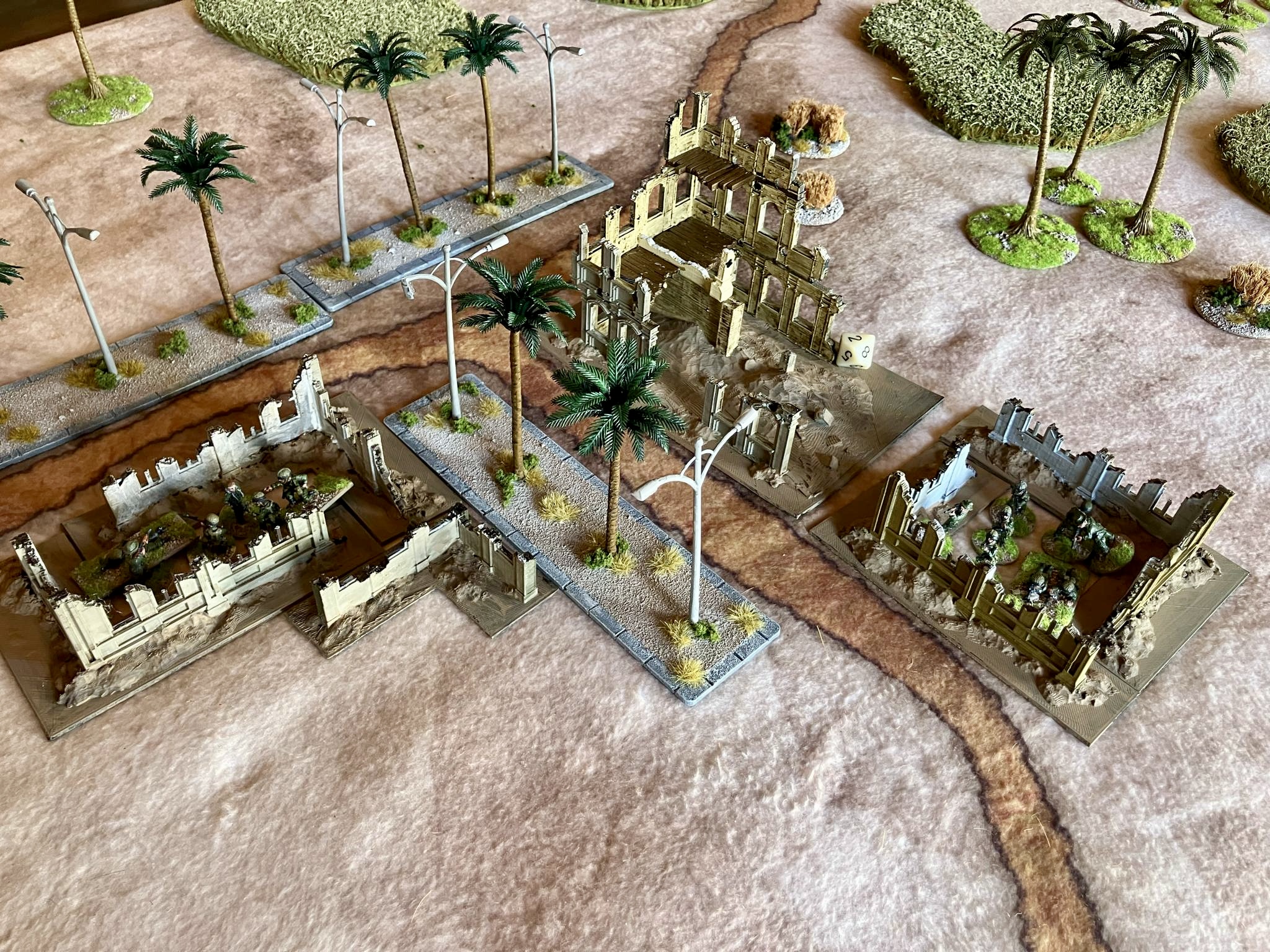
 Pedro and I played a simple Rapid Fire Able Archer.game based on the Israeli attacks west of the Suez in 1973 around the village of Serabaeum. We are play testing the new Able Archer rules before their release later in the year. 


Village is considered as hard cover, observation to fire required, auto observation at 6 inches, armour must morale test to enter village, artillery observation by Observation team and infantry commanders only. Isreali infantry and centurions elite.

Israeli Order of Battle 

243rd Paratrooper Brigade

After taking the village the Orders hold village of Serabaeum for 10 turns against Egyptian counter attack. Support infantry and armour arrives on a D10 turn.

1st parachute battalion (in village) 

HQ 

OC + 5 radio, light mortar team, anti tank team vehicle 

1st company 

8 figs, lmg, grenade launcher 

2nd parachute battalion arrive Radom D10 turn 

HQ 

OC + 5 radio, light mortar team, anti tank team 

1st company 

8 figs, lmg, grenade launcher 

2nd company 

8 figs, lmg, grenade launcher 

Tank Company 

2 x Sho ‘t Meteor Centurions L7 105mm, class 3 gun, class C armour, medium 

Egyptian order of Battle 

Egyptian orders are to recapture the village and prevent the Israelis from taking the high ground to the west of the village. 

73rd Sa’iqa Parachute Regiment  

1st Battalion 
HQ 
OC, radio, sniper, observer element + 2 vehicle 

1st Coy 
RPG, MMG, rifle grenade + 5 + vehicle 

2 Coy 
RPG, MMG, rifle grenade + 5 + vehicle 

3rd Coy 
RPG, MMG, rifle grenade + 5

Support coy 
HMG, 81mm mortar, sagger AT vehicle 

2nd Battalion (arrive on D6 turn)

HQ 
OC, radio, sniper, observer element + 2 vehicle 

1st Coy 
RPG, MMG, rifle grenade + 5 + vehicle 

2 Coy 
RPG, MMG, rifle grenade + 5 + vehicle 

3rd Coy 
RPG, MMG, rifle grenade + 5

Support coy 
HMG, 81mm mortar, sagger AT vehicle 

Armour Battalion (arrive D6 turn) 

Morale tests per company for armour 120mm class 2 gun, D class armour, slow

HQ 
1 x JS3
1 x zSU 57-2

1st company 
3 x  JS3 

Rocket battery 
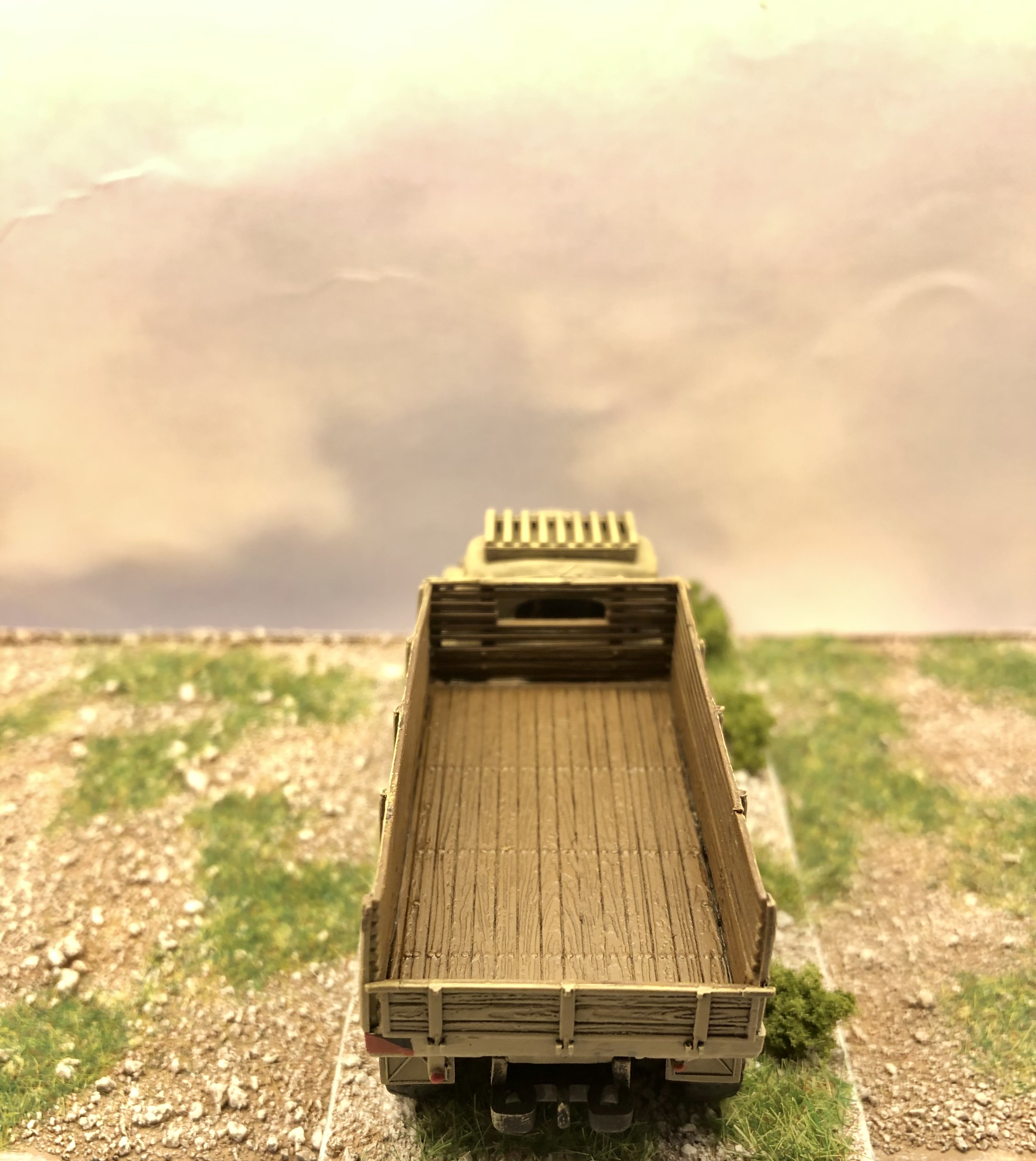
BM13 Katyusha rocket 132mm 10 points table 4, unguided rocket templates 4 rounds, after observation, use rocket template.

The village of Serabaeum

Egyptians arrive, the HQ Armoured coy arrived with the first battalion 


The first IS 3 falls victim to antitank fire

The Egyptians assault 

Isreali reinforcement arrives turn 5, immediately the first centurion is knocked out by long range fire from the IS-3

Israeli reinforcements arrive in the village turn 6


Second of Egyptians battalion arrives 


A draw, Egyptians held the edge of the village, however one battalion was down to below 50% and managed to pass its morale check. 

Tuesday, April 15, 2025

Moroccan T-54 - Yom Kippur War

 A few images posted on the Moroccan army history page, apparently all from Yom Kippur war. I have not seen any of them before so a nice find. I must get my T 54 tanks assembled for my Moroccans. 


Cheers

Matt

Saturday, October 5, 2024

Yom Kippur Syrian Order of Battle

Syrian Order of battle Yom Kippur

Organised along Soviet lines the highly motivated and well disciplined Syrians again prepared for war against Israel to take back the territory lost in the six day war. The Syrian front was the most crucial to the success of the operation against Israel. The Syrian operation was to recapture the Golan heights, reach the Jordan and the Sea of Galilee. The first four days of the operation lead to the largest armour clash since ww2. The non flexible highly centralised command structure really affected the performance of the Syrian army with division commanders directly reporting to the president leading to a total breakdown by day three. Once momentum was lost and the Israelis stabilised then counterattacked, punching to within striking distance of Damascus before the ceasefire. 


9th with T-54/ 55 tanks. 
5th and 7th Divisions each had two infantry brigades, one mechanized brigade and one armored brigade, as well as an Artillery Group and Division units. 
9th Division did not have a mechanized brigade. 
  •  Two armored divisions— the 1st and the 3rd, with T-62 tanks, each with two tank brigades, a mechanized brigade, an Artillery Group and Division units
  • Two independent armored brigades— the 51st and the 47th, and an independent mechanized brigade— the 62nd • 1500 tanks • 1000 artillery gun barrels •
  •  Seven commando and paratrooper battalions 
  • Rifaat al-Assad Force— assigned to secure the regime that included two tank battalions and elite infantry forces 
  • “FROG” SS rocket. launchers 
  • Thirty-six SAM batteries, half of them SA-5
  • 30 SA6 anti aircraft batteries 

Air Force

178 MiG-21 fighter jets
SU 7
114 other fighter jets
forty-five helicopters Mi-8

Sunday, March 17, 2024

Egyptian Army part 1 Transport

 Egyptian army 67-73 part 1 transport

First up some transport for my Egyptians, I have a mix of plastic, Diecast and resin models from grubby tanks, some 3d printed models. The plastic kit include trucks, APCs, midsole trucks, artillery, plus T55s, T34/85 and SU100. I do need to add some more detail bits to them, but good to get them done for our club games next month. 

First up my first troop transport trucks. 


Cheers
Matt

Monday, March 11, 2024

Yom Kippur Egyptian Order of Battle Operation Badr 1973

Yom Kippur War Egyptian Order of battle 

Egyptian Organisation 

The Egyptian army during the fifties and early sixties was based on the English model of Divisions, brigades and regiments. After the revolution in 1952 the country removed much of its ties with the old and drifted towards the Russian Divisional structure, and was fully changed over by 1965. Two armoured divisions, one mechanized division, four infantry divisions were the main force for the invasion.  

Armoured Division 

Structure was two or three regiments per division, each Armoured regiment had up to 31 tanks, with 3 companies per regiment,  each company 10 tanks per company, including a command vehicle for the company commander, the company operated in three platoons. 
Each Tank regiment had a company of one platoon of four  ZSU-57-2 twin barrel 57mm anti aircraft vehicles on a T54 chassis. The majority of the tanks were the T54 or T55 with infrared searchlights, (no white light was possible from these). The T55 were fitted with the latest Soviet stabilisers so they could fire on the move, some of the T54 were also were retro fitted. The 25th independent tank brigade had latest T62 tanks with three battalions, the 21st Armoured division in reserve had a mix of T34/85 and IS3M tanks. 

Mechanised Division

Structure of a division was 3 mechanized infantry battalions. A battalion was formed of 5 companies each mounted in btr152 personal carriers. The division armour was one battalion of 31MBT a HQ coy and three coys, the first and second coys are T55 and T54 and I have found some 3rd company issued with T34/85 (280 with upgrades).  Anti air assets had a Praga AA for the armour and towed assets 40mm bofors and russian ground mounted 30mm ZSU. A recon battalion in BDRM 1 or BDRM 2 and jeeps. A battalion of three companies of 6 tanks each were attached infantry Divisions and consisted of Czechoslovakian  SD-100 assault gun, (they had 148 delivered by 1956, the SD-100 is based on the SU 100) a anti tank company with 9M14 Malyutka sagger jeeps and towed recoilless 82mm were also attached to each battalion of infantry. Other division assets included a Signal company, military police, medical coy and engineer coy. 

Infantry Division 
Structure of the division 2 infantry battalions in trucks and two mechanised battalions along with one tank battalion of three companies a mix of T55, T54 and T34 tanks. 
Each infantry company consisted of a HQ coy and three rifle cots mounted in BTR152 or trucks (second battalion), Soviet RPD machine guns, Belgian bazooka, and B-10 82mm recoiless gun in the HQ. A battalion of three companies of 6 tanks each were attached infantry Divisions and consisted of Czechoslovakian  SD-100 assault gun, (they had 148 delivered by 1956, the SD-100 is based on the SU 100)


130th Amphibious Brigade 
This mechanized brigade was loosely based upon a soviet naval brigade. It had three company’s consisting of a BTR50pk and one of two companies of three PT76’s with an infantry platoon. At the start of the war the brigade had seventy-four BTR-50 or OT-64 SKOT armoured personnel carriers and 24 PT-76 amphibious light tanks.


Artillery (Muqhadem) 

The Egyptian artillery were supplied with soviet 122mm M30 or the 152mm D1. The HQ had a defence platoon, radio exchange and observer element and could be concentrated, six guns made up a battery and three battery’s made up a regiment 

Some armoured infantry artillery regiments were supplied the Frankenstein T34/122 Self Propelled 122mm mounted on the T34 chassis, with two battalions of 18 vehicles in each were in service. 

BM-11 and the BM21 rocket artillery (100 in service)

12 surface to surface misfiles were in service Frog 7 and nine surface to surface Scuds were also in service. 

The Soviet M240  heavy mortar is used upon the positions of the bar ev line, 24 were in service 

Air defence 

Sam 2, Sam 3, self propelled Sam 6, handheld Sam 7, and ZSU 23/4 
12 Commando battalions also took part in the offensive and were divided amount various divisions. The played a reinforcement roles after the Israeli counterattacks successfully crossed the Nile. 

The second and third  Egyptian armies on the Bar Lev line had SU152 in static dug in positions for anti tank positions after the capture of a number of positions. 

Order of Battle Operation Badr


General Command – Anwar Sadat, President of Egypt

War Minister and Commander in Chief, Ahmad Ismail Ali
Chief of Staff – Saad Mohamed Al Hussani Al Shazly

2nd Field Army, General Saad Mamoun/Genl. Abd el Munem Halil.

2nd Infantry Division, Brigadier General Ali Hassan Abu Saada:

4th Infantry Brigade
117th Infantry Brigade
120th Infantry Brigade
24th Armoured Brigade (attached from the 23rd Mechanised Division)

16th Infantry Division, Brigadier General Fuad ‘Aziz Ghali: (Chinese Farm)

3rd Mechanized Infantry Brigade
16th Infantry Brigade
112th Infantry Brigade

18th Infantry Division, Brigadier General Abdel Rab Al Nabi Hafez: 

134th Infantry Brigade
136th Infantry Brigade
15th Independent Armoured Brigade (attached and equipped with T-62)

135th Infantry Brigade (assault force for fort Budapest) brigadier General Salah Abe el-Halim

128th Sa iqa Commando battalion 
Six T34 with flails  
Six OT 64 skot

21st Armoured Division, Brigadier General Ibrahim Oraby 

1st Armoured Brigade
14th Armoured Brigade (detached initially)
18th Mechanised Brigade

23rd Mechanised Division, Brigadier General Ahmed Aboud el Zommer :

116th Mechanised Brigade
118th Mechanised Brigade
129 Commando Brigade 
182nd Parachute Brigade


3rd Field Army, Major General Mohamed Abd El Al Monaam Wasel

Chief of Staff - Maj Gen Mustafa Shaheen
Chief of Artillery - Maj Gen Munir Shash

7th Infantry Division Brig Gen Ahmad Badawi Said Ahmad 

2nd Infantry Brigade 
11th mechanised Infantry Brigade 
8th mechanised infantry brigade  

19th Infantry Division Brig Gen Yusuf Afifi Mohamed

5th Infantry Brigade 
7th Infantry Brigade
2nd Mechanised Brigade  

 4th Armoured Division Brig Gen Mohamed Abd el Aziz Qabil

2nd Armoured Brigade T34/85 & SU 100
3rd Armoured Brigade
6th Armoured Brigade  

6th Mechanised Division Brig Gen Mohamed Abul Fath (southern reserve Suez Canal) 

22nd Armoured Brigade (attached from the 7th Mechanised Division)
113th Mechanised Brigade 
1st Mechanised brigade 
Commando battalions

130th Independent Marine Brigade, Col. Mahmud Sha’ib (northern sector) 

two mechanized battalions each with 10 PT-76 and 40 apc’s (BTR-50 and Skot)
one anti tank battalion
one anti air battalion
one 120mm mortar battalion  
Commando battalion 

30th Independent infantry brigade Col. Mustafa el-’Abassi 


Brigade is tasked with capturing Fort Lahtzanit
Two battalions of infantry
One company of commandos 

25th Independent Armoured Brigade Col Ahmed Helmy Badawy 

96 T-62 tanks


GHQ Reserve, 1st Field Army (West Bank of the Nile)


3rd Mechanised Infantry Division

21st Armoured Division T34/85 and IS3M tanks

Republican Presidential Guard “Brigade” (divisional strength):

Also included:

3 Parachute Brigades:
Western Command (Libya Border) & Southern Command (Aswan/Nile Valley/Sudan Border)
3 Armoured Brigades
2 Mechanised Brigades

Egyptian Air Force 

104th Air Wing 
3 squadrons of Mig -21MF

26th squadron interceptor 
Mig-21 F13 (black raven with a white ’26’ on at least two of their MiG-21s)


Cheers
Matt
  1. 350 T-54s were ordered in 1960 from the Soviet Union and delivered between 1961 and 1966 (the vehicles were probably from Czechoslovakian production line). 150 T-55s were ordered in 1963 from the Soviet Union and delivered between 1964 and 1966. Egypt lost 820 vehicles in the Six Day War  including 82 T-55.  
  2. 800 T-54s were ordered in 1967 from the Soviet Union and delivered between 1967 and 1972 (some of the vehicles were probably from Czechoslovakian and/or Poland production line). 550 T-55s were ordered in 1967 from the Soviet Union and delivered between 1969 and 1973. 50 T-54s were ordered in 1972 from the Soviet Union and delivered in 1973 (the vehicles were previously in Soviet service).

Monday, December 4, 2023

Yom Kippur War - Moroccan history and order of battle


Yom Kippur War Moroccan Army 

Syrian T55 crewed by Moroccans dug in on the Golan, note the white identification cross on the turret and mixed uniforms of the moroccan troops.

Moroccan Army organisation 

The Moroccan army was very different to its fellow Arab nations coming with western style professionally trained and officered by men who had attended the French Military schools and colleges, many of the senior Officers and Ncos had fought in the French army in the Congo, French Indochina, Algeria, and Western Sahara campaigns and then after independence constant border wars with Algeria and the conquest of Spanish Morocco. 

The Moroccan army at this time followed the French “Javelot” divisional doctrine developed in the 50s. The infantry Brigade consisted of four or five regiments of Infantry with attached artillery and if motorised light armour, as required by the task. The infantry Regiment consisted of four to six companies with support elements with enough regimental HQ officers to form small or large subordinate combat sized/battalion teams as required. Each regiment consisted on paper of 812 officers and men and was commanded by a chef de battalion, the regimental support element had two sections of mortars, two sections of heavy machine guns and two sections of light recoilless rifles. Each combat team/battalion as assigned was commanded by a captain. Each platoon was commanded by a 1st lieutenant and sous lieutenant, it had two light 60mm mortars, two MMG teams, two manhandled anti tank weapon teams, and three rifle grenade teams, then typically broken into two fire and movement teams lead by Sergeants. Motorised and airborne regiments had an attached Armoured car or light tank regiment, a motorised anti tank and motorised recoilless rifle platoon plus vehicles to carry the motorised infantry this bought the strength up to 1271 officers and men. Administration and Supply elements were only attached at the brigade level. 

The French Javelot structure was developed originally for nuclear war in Europe but proved its value in the 56 suez crisis, shocking the English with it combat teams approach. It was further developed by the French fighting experience in Indochina, Congo and Algeria and served its purpose for the frontier type fighting of the Moroccan army, during the 60s and 70s. 


Uniforms and equipment 

The infantry deployed for the war were equipped with French uniforms, rank structure and unit structure. The uniform was either medium green or lizard camouflage, the French M51 (American m1) helmet, and French 1950s TAP infantry webbing equipment. 

Personal weapons were very mixed and included the MAS-36  (MAS-36 LG48 and MAS-36/51) and the rifle-grenade capable variants, the MAS-49/56 (airborne & infantry) , FN FAL rifles, AK-47 and the MAT-49 sub machine gun (Officers and Ncos). Squad automatic weapons included the French  AA-52 NF1, MAC 24/29 and the FN Mag-58 were also in service. Heavy machine guns include the American browning 30 cal and the M50 50 caliber HMG. Mortars were Brandt 60mm and the Brandt 27/31 81mm mortar. 

Troops arriving in Syria 


Moroccan Armour and vehicles

The armour available to the Moroccan army in 1973 was 40 Russian T-54B D10 TG 100mm and 80 Czechoslovakian T-54B built models with the latest 100mm D10T2S stabilised gun, included in the Czech order included ten T-54AR and Ten T54 AK command tanks. American equipment was on order and started to arrive in early October 1973, the first delivery of twenty six M48a3 MBTs formed the first tank regiment vehicles by March 1974. A lot of light tanks made up the remainder one hundred and twenty French AMX 13 FL light tanks (4 AMX CD recovery) in reserve. 

Moroccan operated T55s


For the anti tank support role was twenty five Czech built SU-100 SP guns, fifty American M56 scorpion 90mm Self propelled Anti tank guns, (I have not found any record of them being deployed in Syria). Armoured cars were predominantly French, thirty six panhard EBR 75 and one hundred and ninety  Panhard AML 90, thirty AML60-7, forty M8 Armoured cars. Armoured personnel carriers consisted of ninety five Czech OT 64 and forty American M5 and M3 halftracks (ex French stock) and fifty Panard M3 VTT APCs. 

Soft skins in the majority was ex American ww2 stocks. The jeeps were hotchkiss M201(French made - American ww2 Jeep), American mutt jeeps, series II and series III Land Rover Santana (Spanish built) and even some J40 Toyota landcruisers, along with mini Mokes armed with recoiless M20 75mm! 

Moroccan paratrooper mini moke with recoilless rifle and 30 cal. 


Trucks included the Romanian Bucegi SR11 3t, Berliet GBD (6x6), American general M813a1 (6x6) and French ACMAT TPK 425 (4x4) and the TPK 640 (6x6) trucks and I have seen some Simca Marmon also in a parade but nothing in export documents. Mack F900 heavy transport trucks for tank transport.

Anti armour consisted of the hand held M20 super bazooka and the RPG-7, the recoilless rifles  M20 75mm and the M40a1 106mm, towed D44 85mm AT gun and the five hundred MGM 32A Entac missiles. 

Artillery 

Towed systems included twenty American M2A1 (now a M101A1) Thirty eight HM-2 105mm howitzers ( model 1924), eighteen soviet M-46 122mm, and twenty M114 155mm howitzers. Self propelled systems included ninety eight Amx53 155mm sp howitzer, thirty self propelled AMX mk61 105mm howitzer, twenty self propelled M44 155mm howitzer. Thirty six BM-21 122mm rocket launchers 

Anti aircraft equipment 

Information for this part is taken from export lists, but also includes captured equipment. I have more research to do here, but I have types as follows.  Towed systems ninety ZPU-2 14.5mm, nineteen  ZPU-4 14.5mm, ninety Zu 23-2 W23mm, thirty 50 cal M45 Qaud, sixty AZP S60 57mm,  and the missile systems SA-7 Grail, French Hawksystem (cannot locate source for this but have a image of one deployed for the Algerian war in 73) and I am not sure if the MIM-72 Chaparral launchers were available in time for the war. 

Deployment 

 The exact number of soldiers sent by the kingdom to the war remains unknown this day, with two different primary sources conflicting in numbers 5000 and 11000 being noted. Although there was two fronts the second brigade not deploying completely in Egypt time for the ceasefire which may account for the two primary reference confusion to the number of men deployed. 

Moroccan Expedition for the Defense of the Arab Homeland (EMDPA)

Expedition Syria Brigade structure 

Commander Major General Abdel Salam Sefroui

Moroccan Expeditionary Force commander for Syria was Major General Abdel Salam Sefroui, he had a long career and held several positions, including governor of the cities of Agadir, Jeddah, and Al-Bayda, commander of the Light Security Brigade, then director of the Military Academy, then commander of the Royal Guard, ending his career in the diplomatic corps as the Kingdom’s ambassador to the Netherlands. He was the closest general during the reign of Hassan II, where he defended the king in the Skhirat coup until he was injured. He was wounded by a bullet in his knee, as he was wounded 8 times in the Indochina War. 

Chief of staff Lt -Colonel Mohammed Bernichi

Armoured Regiment, Colonel Naji El Mekki 

30 x T55 supplied by Syria (images seem to be green and camo with white cross air recognition on the turret)
10 AMX-13 tanks ( again mixed Moroccan sources not sure if Syrian front , 4 were destroyed, the remainder were shipped back?) 
9 AML90 Armoured cars again this is from a Moroccan source, but does not mention which front, but Syria is likely but not confirmed. . 
Unknown numbers of OT64 if it two supporting regiments of infantry at least 48 if following French doctrine. They are mentioned in Israeli sources in the fighting of the Golan heights villages and strongpoints and are in photos.

Infantry Brigade 2500 men 

Again mixed sources, most sources only mention one regiment on the line, another two regiments, one source mentions that they were reorganised along soviet structure to match the Syrians which could explain the confusion. Syrian and Moroccan bravery commendations were issued to the three regimental commanders for the war, and one regimental commander was killed during the fighting (and the chief of staff replacing him possibly). 

2nd infantry regiment lt Colonel Mohamed Belhaj motorised 

Born August 24, 1936 in Fez, came from Saint Cyr Military School, “Mohamed V” promotion. Appointed second lieutenant on August 1, 1957, was assigned to the infantry, Lieutenant: August 1, 1959, Captain: August 1, 1963, Commander: March 3, 1967, Lt-Colonel: March 3, 1971, Colonel: March 3, 1976, Colonel Major: March 3, 1989, Brigadier General: July 12, 1994, Major General: July 30, 2001 
Decoration and Citations National: Officer of the Order of the Throne: May 14, 1965, Commander of the Order of the Throne: March 3, 1992, Military Merit, Knight rank: April 27, 1976, Citation to the order of the army with war star (crown) April 27, 1976, Volunteer medal (Syria), Moroccan commemorative (Expedition to Syria).
Foreign decorations: Ouissam Al Harbi: 1st category (Syria): November 16, 1973. Ouissam Achajaâ (Syria), Commemorative (Syria), Commander of the French National Order of Merit (1995), National Order (Tunisia): commander rank, National Order (Iran): officer rank.
Service records: Assigned to the 3rd Infantry Battalion in Taza (August 1, 1957), commanded the 14th company in Aknoul. Then the 12th company to: Saka, Benslimane, Skhirat, Khanfouf (Ifni enclave) and Meknes. Transferred to the ARM (at his request) on September 26, assumes the functions of section head of officer cadets and instructor of Arabic, translation, history and geography of Morocco. Transferred to the BQG (June 16, 1964), served as chief of staff to the General, Major General of the FAR from July 15, 1964 to September 1, 1968. Designated to take command of the Royal Military School (Ribat Al Kheir ) from September 1, 1971 to August 30, 1972. Assume the functions of the delegated Arms Commander of the place of Kenitra from September 1, 1972 (1st Company of Kenitra HQ). Part of the EMDPA in Syria, designated by His Majesty the King to command the 2nd Front Infantry Regiment (April 5, 1973, July 15, 1974).
The regiment is mentioned in the fighting on Mont Hebron, had attached thirty Syrian T55 tanks crewed by Morrocans taking part in the first day one of the invasion.  

3rd infantry Regiment Abdelkader Al-Alem motorised

He studied at Ibn Taoumarte college in Sidi Kacem then at Moulay Youssef high school in Rabat . In 1945, he joined the military academy in Meknes where he spent 4 years. In 1950 , he received training for a year in Bordeaux , France . In 1953 on the return of King Mohammed V from exile, he was present among those welcoming him. In 1963 he was promoted to the rank of colonel by Hassan II and decorated. In 1971 , he was injured during the failed coup d' état in Skhirat. In 1973 he leads the 3rd regiment and is killed in the fighting. He was buried in the Damascus cemetery and later returned to Morocco. 

Parachute Commando 
Mentioned attached commando to Syrian units on Mount Hermon, not sure how large this combat unit was, it could of been a section or larger.

Anti tank elements
Motorised Anti tank assets are mentioned attached to the brigade jeeps with recoiless rifles, only photos with no numbers but a section was two vehicles, with three sections to a platoon attached to a brigade. Towed anti tank, no reference of towed antitank being deployed 


Artillery battalion

I cannot find a list of towed or self propelled weapons deployed in the war, however self propelled guns are mentioned supporting the assaults and then defence of the position on the Golan. I also expect the 120mm mortars are along with 81mm mortars within the infantry division. 

Captured Israeli Defa 921 90mm AT gun, looks like a 57mm carriage. 


Moroccan Air Force

I cannot confirm completely that the air force fought in any combat sorties, however reports of fourteen Mig 17 and twelve Moroccan Air Force Northrop F-5A joined the Egyptian 69 Squadron at Tanta on 19 October 1973. Flying missions over the Nile delta after the ceasefire. . 

Fighting in the Golan heights 

The first Moroccan troops arrived by aircraft and then following equipment and men arrived via ship in the July of 1973, training along side the Syrians, the relationship was tense, with the promised armour for the whole regiment only amounting to 30 T55 tanks, rather than 45 (30 does match the Syrian Soviet Doctrine though). 

The brigade is attached to the Syrian 7th Infantry Division. Assigned to the eastern side of the assault on Mont Hermon. The brigade advanced on the 6th of October with the objectives of Hellas-Ovana-Al Qalaa and had one of the first contacts in the vicinity of Tel Sharta fighting against the Israeli 74th Saar tank battalion (7th Armoured div). The Israeli Sho’t Kal outgunned the T55s, however the Moroccans reached their objectives around 1600 southwest of Sahita point and the outskirts of Rouissat-Abi-Ramid. One company surrounding Israelis in the police station at Sahita support point, two other companies occupied two blocks around it, the rest of the forces occupy points around Rouissat. They halted awaiting further instructions, where they were ordered to hold position. On the 7th to the 9th the Moroccans held their position while the 121st Syrian division passed through to continue the assault, where they were badly mauled by the Israelis. 

At 8:40 on October 10, enemy aircraft bombed the positions of the Moroccan forces, focusing their bombing on the Al-Kasha site, height 1480, and Dahrat Al-Hadab. At 11:15, an enemy armored convoy, numbering a tank battalion, advanced from the direction of Masada-Sahita, and Moroccan artillery opened fire on it. At 11:40, a tank company and a mechanized infantry company deployed in front of Sahita and began opening fire on the Moroccan forces, which responded to the fire in kind and stopped the enemy forces on this line. Close to 1:10 p.m., the enemy pushed a group of its tanks to the outskirts of Jubata al-Khashab, threatening the left side of the Moroccan forces. The Moroccan 3rd infantry regiment units, stationed at Heights 1480, Dahrat al-Hadab and the Marj al-Jamous area, were subjected to severe air and artillery bombardment. The Moroccan forces clashed with the enemy infantry forces, then withdrew to the Beit Jinn farm. 

On October 11, the unit faced the Israeli 77th Tank Battalion. Here again, the fighting is fierce. The withdrawal commences east and they find their flank open to counterattack (the Syrian unit had fled). On October 20, it was attached to the 9th Syrian Infantry Division. Device which is organized to launch a counterattack in the Sassa salient. Scheduled for October 25, the operation should make it possible to regain the initiative against the Israelis who are now threatening Damascus, after having restored a situation that was nevertheless desperate on October 6. However, Hafez el-Assad fully realizes that the military situation has become catastrophic. As a result of which he accepted a ceasefire which took effect on October 23, 1973, at midnight... The counter-offensive therefore did not take place and there the fighting of the Moroccan motorized infantry brigade stopped. Despite very tough confrontations, it retained its cohesion throughout the war. In all, 5,500 men were sent to the Golan and Egypt.

The Betrayal of Moroccan troops  

During the withdrawal on the 10th-11th one of the more interesting accounts during the war was the betrayal of Moroccan troops by a Syrian commander. The positions of the Moroccan troops was betrayed to the Israeli troops opposite, according to one source, Mohammed Loma, “Moroccan soldiers were tricked by the Syrian brigade headed by Halawa, a druze commander, who collaborated with the Israelis”. The Syrian army was able to deal with the situation, and executed on the following day commander Major Raik Halawa, who was considered a traitor. The Moroccan martyrs were also mentioned by Sasa Post. 

Expedition Brigade Egypt Colonel Major Hassan Al-Hatmee 5500 men

A second brigade was assembled to assist on the Egyptian front but arrived to late to participate in the fighting. When they arrived they were positioned around the town of Suez, and built defensive positions along the Bir Azeib, a strategic location defending access to the two roads leading to Cairo. 

Moroccan troops finally returned from Egypt and Syria in April 1974. 170 Morrocan died during the war and 6 were captured. 

References 

Websites
Moroccan army history forum

YouTube


Books 
After The Storm: The Changing Military Balance in the Middle EastBy Anthony H. Cordesman
Foss, Christopher F. (1974) [1972]. Jane's Pocket Book of Tanks and Armored Fighting Vehicles. Collier Books.
Osprey Arab armies Yom Kippur war
MIG productions Arab Armies volume 3
Estes, Kenneth W (2016). M50 Ontos and M56 Scorpion 1956–70: US Tank Destroyers of the Vietnam War

Details on the betrayal by the Syrian commander 


Wednesday, November 22, 2023

Yom Kippur War Jordanian Order of Battle


Yom Kippur War Jordanian order of battle

Photos from the Jordanian tank museum 

The least enthusiastic participant in the October fighting was probably Jordan. After the Arab offensive began Jordan commenced calling up reserves on the 10th of October. The 40th Armored Brigade was sent to the North eastern front in Syria the threaten the Israeli border and protect the flanks of the Syrian counter attacks. 

The 40th Armoured Brigade crossed the border on the 12th and arrived in position on the 13th and were then attached to the 3rd Iraqi Armoured division. On the 14th the division was assigned to the southern flank of the counter attack. The assault occurred between Jubata al Khashab and Khan Arinbeh, with the goal of forcing a front to highway 98, near Al Qunaitra and the high ground. This ground was not very suited to Armoured formations as it consisted of volcanic rocks, small ridges, gullies and outcrops, with a number of villages, plus overlooked by high ground that could be defended easily by the Israelis.

 The 40th were placed on the left flank of the Iraqi division, the attack began at dawn on the 16th after a preliminary bombardment of Jordanian, Iraqi and Syrian artillery. The assault began successfully until at 4000m the first centurions were lost to TOW missiles, however the creeping barrage by the Jordanian artillery forced the Israeli infantry to retire and the centurions possibly being mistaken as Israeli armour penetrated the line, in the confusion the Jordanians claimed 20 Israeli tanks, 9 TOWs and three jeeps destroyed or captured for the loss of 14 tanks destroyed, forcing the Israeli troops to withdraw. On the 17th and 18th damaged vehicles were refitted for a renewed assault on Israeli positions on dawn of the 19th, however the assault went in piecemeal and the Jordanians lost a further 4 tanks destroyed, but the Iraqis in the centre were badly mauled. A further assault was planned on the 23rd of October, but never went forward due to the ceasefire. The Jordanians suffered 28 killed and 49 wounded, with the loss of 33 tanks, 18 destroyed and 9 damaged but recovered, and 6 captured by Israel and 2 APCs damaged. 

A good indication of the Jordanian camouflage, medical M113 of the 40th division, the photo I believe is from 1970 during Black September. 


40th Jordanian Armoured Brigade Khalid Hajhouj al-Majali 

Brigade HQ 
Signal Company
Prince Hussein bin Abdullah II 1st Armored Infantry Battalion M113
2nd Royal Tank Battalion  45 Mk7 105mm Centurions
Prince Ali bin Al Hussein 4th Tank Battalion 45 Mk5 105mm and Mk7 105mm centurions
Services Companies
Medical Company
Brigade Maintenance Workshop Centurion ARV
Field reconnaissance battalion 9 x FV-701 Ferret 

A Jordanian M48 with three 44 gallon fuel drums on the rear. 


Photos from the Jordanian Armour museum


Division Artillery HQ
2nd SP Artillery Battalion 10? M110 howitzer
7th SP Artillery Battalion 10 M52 105mm self propelled howitzer
23rd SP Artillery Battalion 8 M52 105mm self propelled howitzer
18 × M-42 Duster 40mm SP AA 


Jordanian M42 duster, photo from the Jordanian Tank Museum 

References

Historical encyclopedia of the Jordanian armed forces
https://www.jaf.mil.jo/Assets/File/hestoryPdfEn.pdf


Wednesday, November 15, 2023

Praga 53/59/70 30mm Anti Aircraft gun - NB models kit review


Praga 53/59/70 30mm AA Lizard

History Praga 53/59


The Praga M53/59 was developed post ww2 and entered service in 1959, mounted on a armoured cabin, the cabin armour was quite thin 10mm on the front and 6mm on the sides making it small arms fire proof only. The vehicle was the Czech V3S 6 wheel drive truck chassis. The chassis, engine and electronic components were upgraded and improved in 1970, these vehicles became the M53/70. Further electronic additions were added in the eighties so electronic air tracking was available via connection to a battery command vehicle using the M85 Zirafa radar allowing it to remain in service for some time in the Czechoslovakian army until 2003. A large number of both models were exported during the Cold War and quite a number still remain in a number of armies today. 

The 30mm cannon was originally designed by Bruno for the kreigsmarine during ww2 as a submarine anti aircraft design. The Czechoslovak designation was the 30mm PLDvk viz.53. The top mounted magazines for the gun held 50 rounds, however weighed a hefty 85 kilos when fully loaded. The guns had a practicable rate of fire of 150-200 rounds per minute, AA effective range was 3500m and on ground targets 2000m. The gunner had optical sights only and manual trigger and hydraulic assisted traverse and elevation, until the 1980s when the upgraded system appeared for targeting. The twin guns could also be dis-mounted from the chassis into a fixed ground position. The vehicle had a crew of five, Commander, driver, two loaders and a gunner, and normally operated in a division of 6 vehicles, plus a command vehicle for the battery of two divisions. 

The Praga had the nickname the lizard due to its code name during its development and was widely used in the ground role during the Yom Kippur war and the Yugoslavian wars, where Praga became the nickname for all anti aircraft SP cannons. 

Review NB models Praga 53/59

A superb offering of the Praga 53/59 30mm SP AA gun by NB models. This is the 1/72 version, there is also a 1/35th scale available too. 

A very crisp 3d print with very little clean up, a bit of light filing and sanding where the supports were, predominately on the underside of the pieces and on the back of the Gun. A little sanding and it was ready to assemble. Assembly was simple and straight forward and  every thing nicely together with no problems, I used super glue gel for assembly giving me time to square up wheels and the gun assembly.

My only critiques are, I would of liked the tyre treads on the wheels to be more detailed, a posable gun for the deployed AA role with removable and spare ammunition drums plus the racks and finally the crew compartment to be open so I could add crew, a gunner and loaders. 

I will mount this on a base to prevent it being knocked about whilst it is on the game table as I can see the mirrors and rear steps becoming detached quickly.  I also left off the clear canopy for painting as it can easily be placed after painting. One will join my Egyptians the other my Iraqis, and I will possibly get them painted before Christmas! 

The Praga 53/59 NB models kit fully laid out, a very crisp kit


Cabin detail is excellent, a few delicate parts…. A few bits to clean up but overall great


The NB models Praga 53/59 Guns and cabin front, the light mounts and mirrors are superb


NB models Praga cabin side, the tools are superb, as are the lights, handles and mirror


The Armoured glass cupola and gun sight…. 

Cheers

Matt 
References 
AK interactive- vol III Arab revolutions and border wars. 
You tube training clip of the Praga 53/59 
Praga 53/59 walk around 
Yugoslavian wars use 

Tuesday, November 7, 2023

Terrain Tuesday - Desert terrain part two

 Desert terrain 

Last week as the Yom Kippur War bug continues to bite I completed some desert shrub foliage cover pieces that could be used for both 20mm and 28mm. Simple mdf base with coir hair mat and, home made tufts and some noch shrub. Quite effective and happy with the result, 30 odd more to come once I make some new tufts in the coming week or so. 

Desert tufts 


Cheers
Matt

Sunday, October 15, 2023

Egyptian Army Part 1 Infantry

 Egyptian Army 1967-73 -Infantry 

The infantry for this project are from Elhiem miniatures. The figures are from the middle eastern range which will work for most middle eastern nations during the period. They have a good variety of poses and I am really happy with my results. 

Painting guide Egyptian Infantry Arab Israeli wars

I have researched the uniforms and decided to go a little darker than the sand colour recommended in battlefront fate of nations guide. I use a black undercoat, a base colour, the wash, then Highlight the same colour. 
Flesh Vallejo dwarf flesh, highlight about 10% elf flesh, Warpaint brown flesh wash. 
Tunic and trousers Vallejo panzer aces French tanker uniform
Webbing AK khaki webbing
Helmet Vallejo Russian uniform
Wood Rifle Furniture Vallejo mahogany
Weapon metal work Vallejo German grey 
Boots Vallejo German grey 
Support weapons and RPG is Vallejo German camo green
Airborne Berets Vallejo dark red, then blood red highlight. 
The grass tufts are my own using either Noch or faller flocks. 

I am really happy with these chaps and they will also double for my Iraqis. 

1st Motorised regiment

The motorised truck units had a structure of ; One  HQ company and two rifle companies and one support company. I have 6 trucks almost completed for these chaps, plus two command Zil 157 vans. I also need to print some Soviet jeeps for the Sagger crews to complete the regiment.

1st Battalion


2nd Battalion 


Armoured infantry battalion 

I need to add a sniper to this battalion and some heavy weapons. I am having trouble finding a decent order of battle for these with conflicting sources for the structure of the battalions. I have followed the Russian structure for them. A HQ and two rifle companies, with two in the BTR 152 or BTR 50. I have ordered extra vehicles so I can depict 1967 and 73 formations. 


Airborne battalion 

The Egyptian airborne infantry chaps need a few more figures to complete them, this will include some head swaps to get more variation and radio op and heavy weapons. I need to do another order with elhiem shortly. 


Cheers
Matt