Thursday, August 20, 2026
Swedish Ford Bronco
Saturday, April 25, 2026
336-я отдельная гвардейская бригада морской пехоты - 336th Separate Guards Marine Brigade
336-я отдельная гвардейская бригада морской пехоты
336th Separate Guards Marine Brigade
The 336th consisted of three battalions of Naval Infantry equipped with the amphibious BTR 60 armored personnel carriers, a tank battalion with two companies of PT-76 amphibious light tanks and a company of T-55 main battle tanks. Artillery support was provided by a battery of BM-21 Grad multiple rocket launchers and a battery of anti-tank guided missiles, while air defense consisted of a platoon of ZSU-23-4 Shilka anti-aircraft guns and a platoon of 9K31 Strela-1 surface-to-air missiles. Support units included support, reconnaissance, engineer, and NBC defense battalions.
Brigade Headquarters
877th Naval Infantry Battalion
BTR 60 PB
878th Naval Infantry Battalion
BTR 60 PB
879th Naval (Air Landing) Infantry Battalion
884th Naval Infantry Battalion
112th Tank Battalion
887th Reconnaissance Battalion
1612th Artillery Battalion
1618th Anti-Aircraft Missile Battalion
1615th Multi-Rocket Launcher Artillery Battalion
1621st Anti-Tank Artillery Battalion
2 x MT-12 Rapira 100mm's
2 x BRDM-2 Konkurs
Engineer battalion
Sunday, March 22, 2026
Swedish Terrängbil m/42
![]() |
Saturday, October 11, 2025
Cold War British Paratrooper Organisation
Upcoming Project this winter is to add to my Cold War Brit’s using platoon 20 and Britannia miniatures for my Rifles, Paras and Irish
Monday, September 15, 2025
Katanga Airforce Fouga Magister KAT 92
![]() |
| KATANGAN 92 Fouga Magister |
Saturday, September 6, 2025
Fouga Magister CM 170 - AVIKAT Katanga Airforce
Katanga Airforce Fouga Cm-170 Magister
The Fouga Cm-170 Magister is a first generation two seater jet trainer. Its distinctive V-shaped tail makes it easily recognisable to most aviation lovers. While primarily operated as a trainer aircraft, the Magister was also used in combat as a close air support platform by 22 air forces. It saw action during the Six-Day War, the Salvadoran Civil War, the Western Sahara War, and the Congo Crisis. The Magister was also chosen by many aerobatics display teams, including the Patrouille de France, the Belgian Red Devils, Brazils Smoke Squadron, Austrian Silver Birds, the Luftwaffe flying school FlugzeugFuhrerSchule and the Irish Silver Swallows. The Fouga Magister was nicknamed "the whistling turtle" by the Belgian Air Force and the “whistling Rooster” by the Finns due to the motor whistling while in idle.
The aircraft could be equipped with two 7.5 mm or 7.62 mm nose machine guns and had two hard points for bombs or missiles.
The Fouga Magister in AVIKAT service
In 1960, after the independence of Congo, the province of Katanga separated and became an independent republic. The President of Katanga, Moïse Tshombé, ordered 9 planes from Potez Air Fouga. Only three aircraft were delivered to Katanga at Luano (Elisabethville airfield). On February 15, 1961, the arrival of the three Katangese Fouga was announced by the "Daily Mail" of February 6, 61.
The six Fouga Cm-170 Magisters that were still to be delivered to the Katangese government were in Pointe Noire (Congo Brazaville) in October 1961. But following the UN embargo, the ship brought them back to Antwerp where they were taken care of by customs. These were later sold to the Irish Airforce.
AVIKAT Markings

Katangan Fouga KAT 91.
It crashed on June 23, 1961, during a maneuver over the old Eville runway.
Very few photographic documents exist of it.
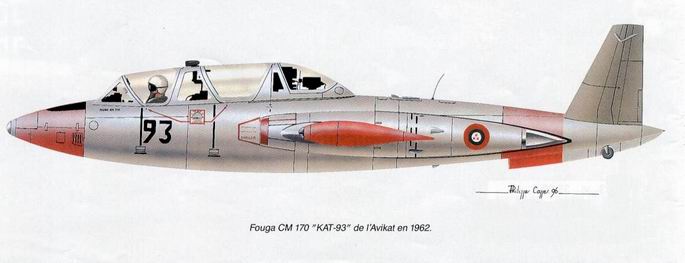
Katangan Fouga KAT 93
Its engine was being repaired when the UN launched Operation "Rhum Punch" on August 28, 1961, which aimed to expel foreign personnel from the Gendarmerie and the Avikat. KAT 93 flew a few missions but was seized by the UN at the end of August 1961. 
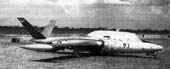
The most common depicted AVIKAT Fouga

KAT 93 in front of the Luano control tower.

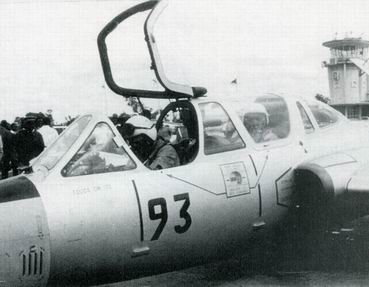
KAT 93 on the tarmac at Luano. President Moïse Tshombe sits in the passenger seat
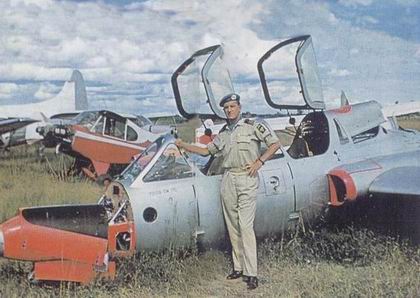
Standing next to KAT 93 the Swedish Air Force Colonel Sven Lampell, head of ONUC air operations and head of the UN fighter wing which included the "F22" Saab J-29 squadron, the Iranian Sabre jet squadron and the Ethiopian Sabre jet squadron.
| The most common depicted AVIKAT Fouga |
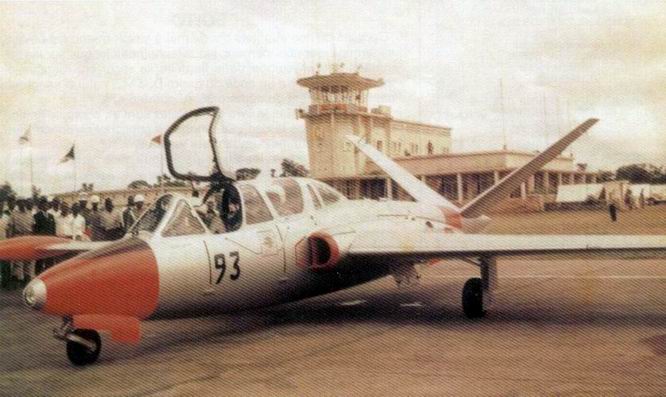
| KAT 93 in front of the Luano control tower. |
![]() |
KAT 93 on the tarmac at Luano. President Moïse Tshombe sits in the passenger seat |
Katangan Fouga KAT 92

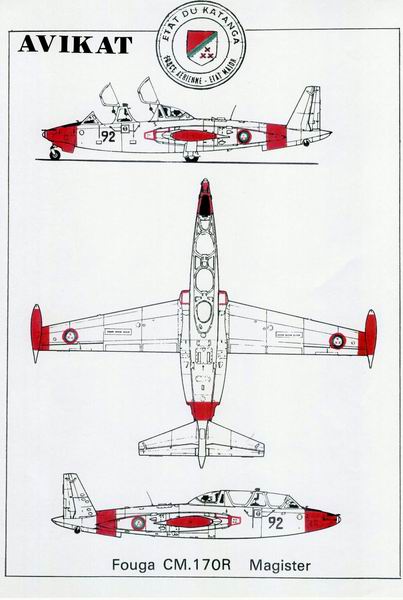
Markings for AVIKAT aircraft
Without a doubt, the most infamous of the Katangan Fouga Magisters, KAT 92 seen the most service and caused the most controversy. Kat 92 operated from September 14 to 19, 1961, against UN forces. Damaged by ground fire on the 18th but grounded while peace talks commenced and then came into effect on the 20th.
On the 3rd December 1961 it was damaged during an air attack, Indian UN Canberra bombers permanently grounded it at Kolwezi. Damaged, it was evacuated by rail on December 5, 1961, to Kisenge where it awaited replacement parts.
Thanks to this single training aircraft, based in Kolwezi, the Katangese "hunt" caused panic among the United Nations. The KAT 92 carried out rapid overflights of UN positions, dropping a few 50kg improvised bombs here and there. These interventions boosted the morale of the Katangese Gendarmerie and mercenary troops and sowed consternation among the ranks of the ONUC troops. The Fouga were an excellent means of psychological warfare against the ONUC soldiers and forced them to deploy air support. This Fouga also played a vital role in the attack on UN Kamina Airbase on the 15th, 16th, 17th and 18th of September destroying one DC4 on the ground and killing two UN pilots. Then the strafing and bombing of the Irish at Jadotville between the 13th and 17th. During at ground attack on the Kamina Airbase on the 18th it received damage.
José Magain “the lone Prowler”The pilot of the Fouga 92 was the Belgian José Magain who had flown with the Belgian Air Force. Joseph Delin the commander of Kolwezi airbase accompanied him as co-pilot on several missions including the staffing of Jadotville But when the journalists and photographers showed up in Kolwezi, José Magain disappeared… because no one could know that he had piloted the Fouga Magister. In reality he should no longer have been in Katanga and should have returned to Belgium on August 28, 1961, just like the other members of Avikat expelled by the UN (Operation “Rumpunch 27th August - October 1961”).
Armament for KAT 92, originally armed with 7.50 mm guns and ammunition, it was re-chambered for 7.62 caliber as ammunition was readily available. for bombing ground attack missions required manufacture of 50 kg bombs from mortar rounds and a primitive dropping and aiming system organized with the means at hand. The Fouga KAT 92 flew about 50 missions, claiming a UN DC-6, a DC-4, a DC-3, a dozen trucks, strafing the positions Jadotville, and a UN radio installations was destroyed at Kamina. The end of each of these missions was punctuated by a message to the control tower manned by the UN: "See you soon, gentlemen; I will be happy to come and see you again!"

“The Ghost Sqaudron” a dummy aircraft on Kolwezi runway
| Markings for AVIKAT aircraft |
![]() |
| “The Ghost Sqaudron” a dummy aircraft on Kolwezi runway |
Hammarksjöld “affair”
. 
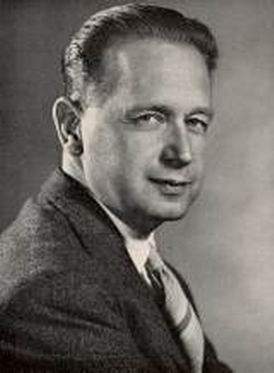
The event that has attracted the most attention regarding KAT 92 is the crash of Dag Hammarksjöld's DC-6 on September 17, 1961. Dag Hammarksjöld was the Secretary-General of the United Nations and was dispatched to the Congo to try to resolve the crisis.
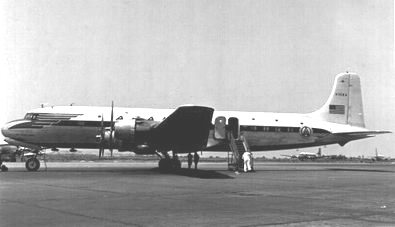
On the evening of September 17, his plane took off from Leopoldville for N'Dola. He was going there with the aim of meeting Moïse Tshombé...… The DC-6, "Albertina", never landed in N'Dola and crashed around midnight on a hill near N'Dola. Initially, the Fouga Magister KAT 92 was accused of having shot down the plane of the Secretary General of the United Nations, later it is thought a De Havilland Dove that did have night flying ability dropped mortar bombs onto the aircraft.

DC-6 “Albertina” registered SE-BDY which transported UN Secretary General Dag Hammarksjöld on September 17, 1961.
The international commission of inquiry sent to the scene by the UN to analyze the causes of the crash concluded that the reasons were certainly accidental. This same international commission from Rhodesia went to Kolwezi on October 20, 1961 to monitor the activity of the Fouga KAT 92 on the day of Mr. Hammarksjöld's death. On site, Major DELIN proved to them that the aircraft's autonomy was insufficient to reach N'Dola and, what's more, the Kolwezi airfield was not equipped for night flights. This exonerated (officially), at the same time, the Belgian pilot of the Fouga, Joseph Delin... (unofficially) we have since known that it was José MAGAIN who was the jet's assigned pilot!
CheersMatt

On the evening of September 17, his plane took off from Leopoldville for N'Dola. He was going there with the aim of meeting Moïse Tshombé...… The DC-6, "Albertina", never landed in N'Dola and crashed around midnight on a hill near N'Dola. Initially, the Fouga Magister KAT 92 was accused of having shot down the plane of the Secretary General of the United Nations, later it is thought a De Havilland Dove that did have night flying ability dropped mortar bombs onto the aircraft.
![]() |
| DC-6 “Albertina” registered SE-BDY which transported UN Secretary General Dag Hammarksjöld on September 17, 1961. |
The international commission of inquiry sent to the scene by the UN to analyze the causes of the crash concluded that the reasons were certainly accidental. This same international commission from Rhodesia went to Kolwezi on October 20, 1961 to monitor the activity of the Fouga KAT 92 on the day of Mr. Hammarksjöld's death. On site, Major DELIN proved to them that the aircraft's autonomy was insufficient to reach N'Dola and, what's more, the Kolwezi airfield was not equipped for night flights. This exonerated (officially), at the same time, the Belgian pilot of the Fouga, Joseph Delin... (unofficially) we have since known that it was José MAGAIN who was the jet's assigned pilot!
Wednesday, August 6, 2025
Mig 15 UTI Midget -Wip Wednesday
A quick hobby boss Mig15 UTI midget build over the weekend in between battlefield tours. A very basic kit and simple rapid build kit. I completed the build on Sunday. I am planning a stationary build that I can use for a special forces raid. Hoping for paint job on Thursday or Friday as I need to complete another Mig 21 in the same camo!
Cheers
Matt
MiG 17 PF WIP
MiG 17 PF WIP
Monday, June 16, 2025
SU -15 TM PM models
Flagon SU-15TM
Monday, May 19, 2025
Terrain Tuesday - Hot food van
Hot Food Van
A Citroen Hot Wheels car was picked up a few weeks ago whilst shopping, I opted to paint it in split colours. I do intend adding a table and garbage bin on the grassed area as soon as I find them in my model railway bits box, it will join my Cold War collection. Now I need a name for it! My wife suggested to call it Matts chew and spew….. as she detests take away….
Happy with the results
Cheers
Matt
Thursday, May 15, 2025
A-10 Thunderbolt Hog
Thursday, May 8, 2025
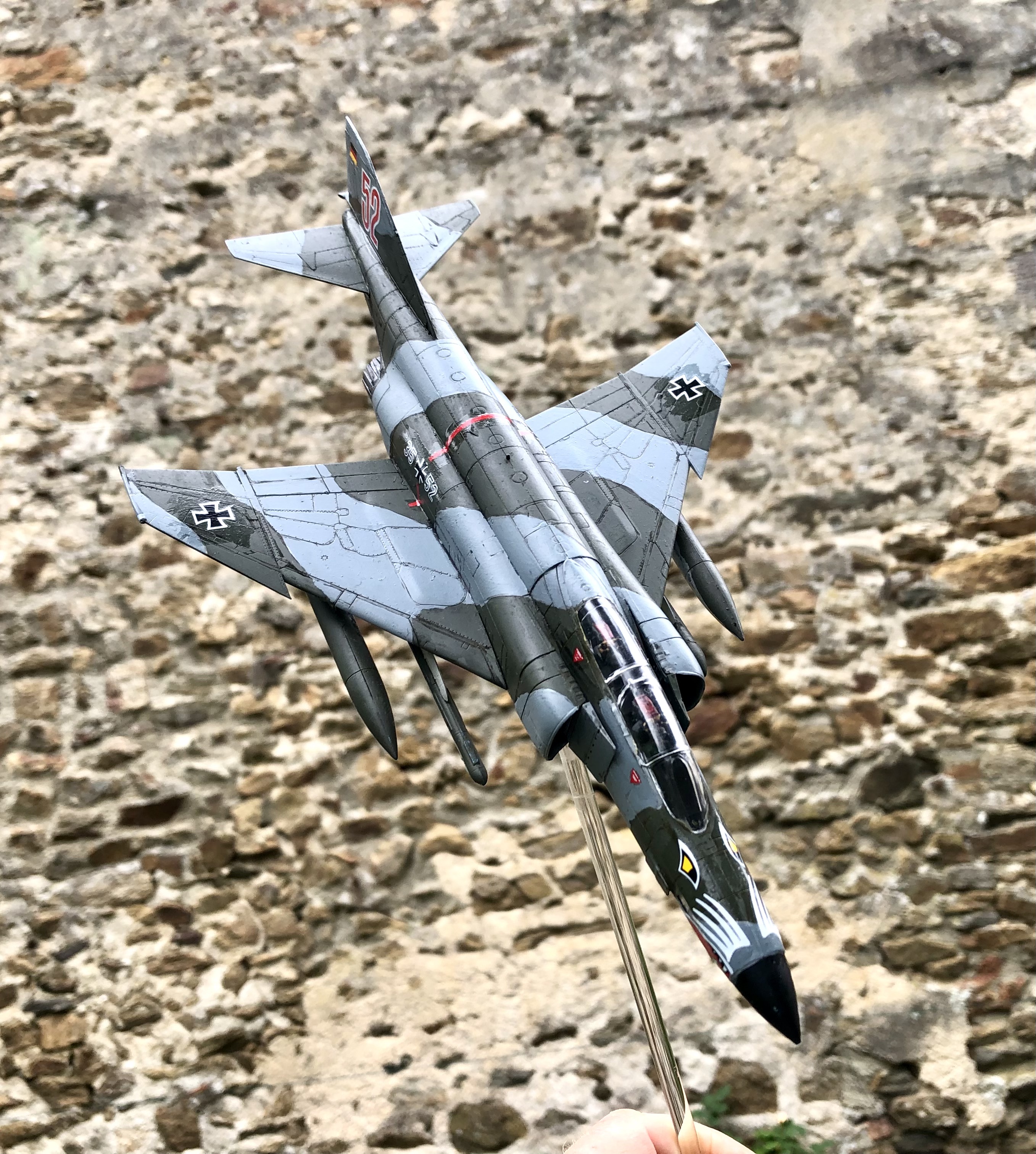
Luftwaffe F4 phantom
Luftwaffe F 4 phantom
Monday, May 5, 2025
Warpac NBC checkpoint
A bit slow this week, after a month of assembly of plastic kits. This weekend I pulled out some Soviet NBC chaps from the moderns project draw. The figure with rifles are from a old Esci box of Warsaw pact figures, the figure with the note board is from Airfix I think
Cheers
Matt
Sunday, February 16, 2025
Bundeszollverwaltung VW T1 van
Saturday, February 15, 2025
Civilian Cold War VW beetle
VW beetle
I am always on the lookout for civilian bits that will fit my Cold War scenes, I was excited to come across a hot wheels collection of VW cars which in due course will hit the painting desk. This one my my wife’s mothers car in the 80s. Very snazzy at the time in two tone orange and white.
Cheers
Matt
Thursday, February 13, 2025
Bundesgrenzschutz Part 10
Bundesgrenzschutz Cars
Tuesday, February 11, 2025
Terrain Tuesday
A few more bits for the table , another wayside cross and a US supply dump suitable for ww2 and Cold War games and objective markers.
Cheers
Matt
Thursday, February 6, 2025
Modelling US 155mm ammunition
Modelling Ammunition for the 155mm
Building some 1/72 italeri 155 kits for my English and American heavy artillery batteries, the models come with a bunch of ammo so I needed to research US 155 ammunition. The US army technical manual images are a good resource for model builders who want to get correct ammunition for their artillery scene, and 1/35th scale modelers also. The 155mm was used by the heavy batteries in every theatre including the pacific. The gun is still in use today in a number of nations so this is also useful for Cold War and current conflicts.
![]() |
| The simplest reference! |
155mm Transport
The shells were stored it was in a crate which was on a pallet. It was rare for a pallet to make it to the front as it was broken down into carry cases for delivery to the front, it was then broken down again at the gun supply point, a 2 1/2 ton truck could deliver 55 shells this way enough for at least one or two fire missions per battery.
The Shell
The 155mm High Explosive (HE) shell was the most commonly used ammunition for the 155, but chemical white phosphorus (WP) smoke and illumination shell was also available. The HE shell was green with yellow writing, the WP was blue grey with a single yellow horizontal band and yellow writing, the illumination shell (LU) had a white band and yellow writing. The shell was fitted a lifting ring on the nose and a rope (and later a rubber grommet during late 43 to Vietnam, then a metal/ rubber clamp up to current) on the end of the round to to protect the copper rubbing and movement whilst be transported. The round weighed 95 pounds/43 kilo so was a two man lift at minimum on a cradle. At 20mm it would be difficult to mark but at 28mm add D544 on the HE body.
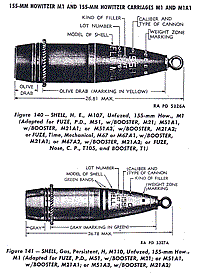
The Fuse Cap
The fuse caps was stored in a OD green crate that carried 25 fuses with a spanner. The shell lifting cap was grey and screwed out so the detonator Fuse cap could then be fitted, which is either gun metal, black or green before depending upon mission type before it was loaded into the gun.
The Propellant Charge
The cloth charge bag was carried in fiberboard containers packed in three with a triangular protective box. Inside were either three :- M14 37.75 inches long and 6.38 inches diameter it held two M3 Charges, this charge could be reduced depending upon range required. Or the M13 27 inches long and 7.38 inches diameter this held one M4a1 charge. The powder bags are color coded; charges 1-4 are green, 5-7 are white, and 8 is red, the bottom of the charge badge has a red mark to face the igniter on the gun.
Fiberboard transport container
I hope that is helpful
Cheers
Matt